
Sustainability as a Key Consideration from the Earliest Project Stage
Sustainability plays a crucial role not only during the design and implementation phases, but already at the project preparation stage. Realiscon is currently working on the BREEAM Communities certification of a district-scale development, which is only the third such assessment in Hungary. The scheme evaluates sustainability in a comprehensive, structured and measurable way already in the early stages of the project, covering aspects such as environmental impacts, transport and infrastructure connections, community functions, as well as social and economic sustainability.
The Role of Sustainability Decisions in the Early Stages of Development
In Hungary, there are still relatively few district-scale developments or revitalization projects where sustainability goals are defined in a structured way using a measurable framework. Yet, at this stage, key decisions can already be made regarding how the development will be integrated into the existing urban fabric—its transport systems, green infrastructure, or the energy strategy guiding the design process even before specific buildings are planned.
Unfortunately, it is often observed that developments begin without proper preparation, relying on conventional solutions, methods, and assumptions. However, in projects of this scale, beyond the mandatory preparatory studies and assessments, valuable additional information can be gathered to support even the initial site planning decisions.
Such analyses may include, for example, flood risk assessments specific to the site (considering both natural and built environmental factors), examination of opportunities for reuse and recycling of buildings, structures, or materials in line with circular economy principles, acoustic measurements alongside projections of expected noise impacts, and the development of plans aimed not only at protecting existing ecological values but also at enhancing biodiversity.
It is also essential that the planned functions consider not only financial return but also the needs of the local community—for example, by identifying gaps in education, housing, services, or recreational opportunities.
BREEAM Communities as a Guiding Framework for Sustainable Urban Development
If a development places additional pressure on existing transport systems, affects adjacent public spaces used by the community, includes residential construction, or necessitates new services, it becomes essential to apply a well-structured, design-supportive criteria system that considers environmental aspects at a high level alongside community interests.
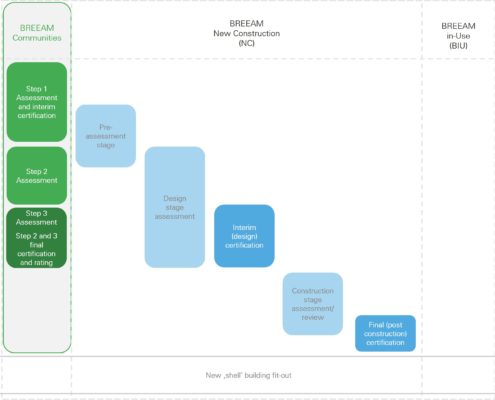
The British BREEAM Communities framework provides a structured, measurable “green” set of requirements to support the preparation of such large-scale developments. It promotes solutions that enhance sustainability at district level by defining both mandatory and optional criteria — many of which should already be considered standard practice today.
Long-Term Benefits and Adaptability through BREEAM Certification
In Hungary, only three developments have been completed or are currently underway applying the above-mentioned certification system.
In the case of the ongoing development of the former brick factory site in Törökbálint, the mandatory studies required for BREEAM Communities certification were completed by April 2026. These studies are intended to support decisions such as selecting the optimal energy strategy that balances carbon reduction with return on investment. In addition, sustainable transport solutions have been developed to address and alleviate pressure on the existing transport network.
An ecologist assessed the site’s current ecological values and defined guiding principles for enhancing these through future landscape and urban design. Economic and demographic analyses were also conducted to map the needs and opportunities of the local economy, taking into account the demands and expectations related to the development. A core element of the entire process is continuous communication and consultation with stakeholders, contributing to the creation of a sustainable, socially responsible, and economically successful development that meets not only present but also future needs.
Commitment to BREEAM certification ensures that the development minimizes its negative environmental impacts, remains adaptable to climate change and socio-economic shifts over the long term, and becomes more attractive and acceptable to all stakeholders involved.


