Mastering circular economy

In January 2025, I was shocked when I looked at our Power BI sustainability report.
Two numbers immediately stood out:
- We had used 12,000 garbage bags in 2024.
- During peak periods, the garbage truck collected several hundred kilograms of waste from us every week.
And this was despite having dozens of selective waste collection points across our facility.
The issue kept bothering me because we had already placed a very strong emphasis on selective waste collection.
So one Sunday, I personally went “dumpster diving” — collecting and analyzing the contents of our waste bins.
The next day, we held a staff training session focused on waste management. I brought the previous day’s garbage into the meeting room and emptied it onto a large plastic sheet.
Within minutes, we reached two very clear conclusions:
- Even though we provided selective waste collection, visitors did not consistently separate waste correctly. Selective bins contained mixed waste, while recyclable materials often ended up in general waste bins.
- A significant portion of our garbage bags were still perfectly usable when thrown away.
In other words:
our selective collection system was far less effective than we believed — and, painful as it is to admit, we were wasting garbage bags as well.
At that point, my mind went back to 1992, when I wrote my MBA thesis on the then-revolutionary concept of Business Process Reengineering (BPR).
The essence of BPR is simple:
learn to think outside the box and eliminate the “ugly worms of habit.”
So we started redesigning the entire process.
We immersed ourselves in circular economy thinking, added a small technological innovation, and eventually achieved what felt like a small miracle:
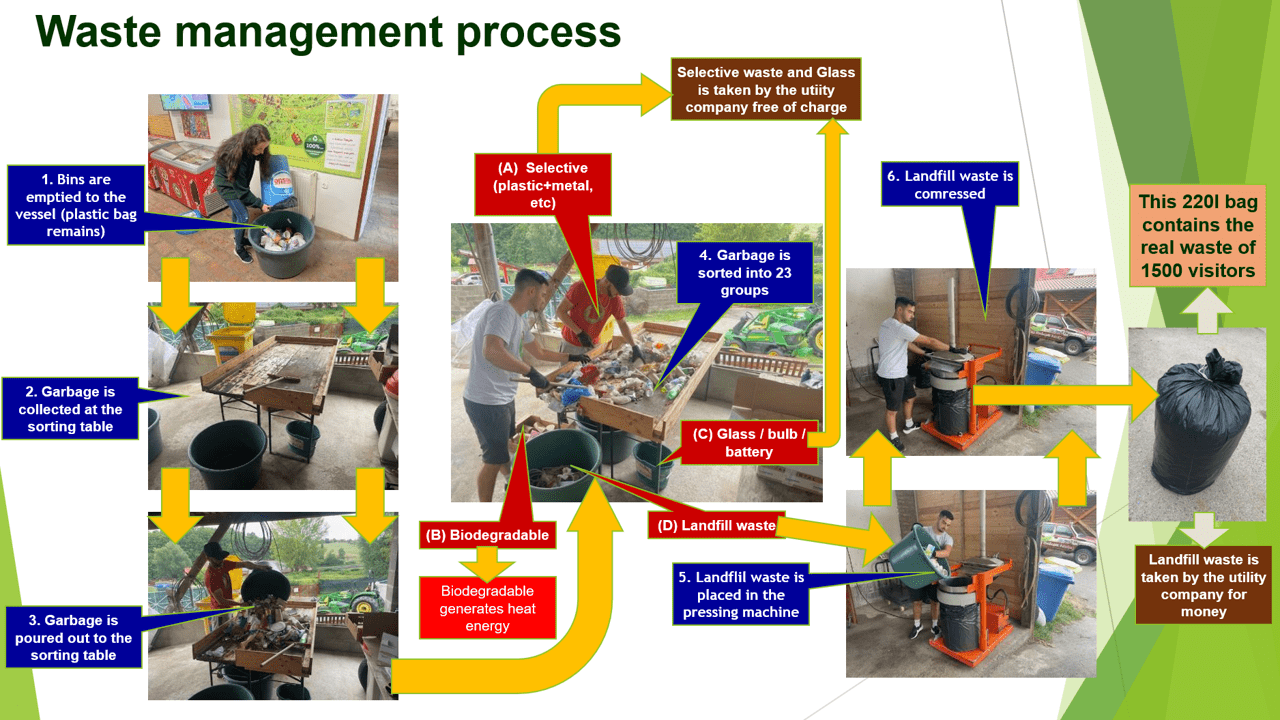
With just 10–15 minutes of additional daily work, the real waste generated by 1,500 visitors now fits into a single 220-liter bag.
So what changed?
- Instead of placing garbage bags inside large bins, we reversed the logic:
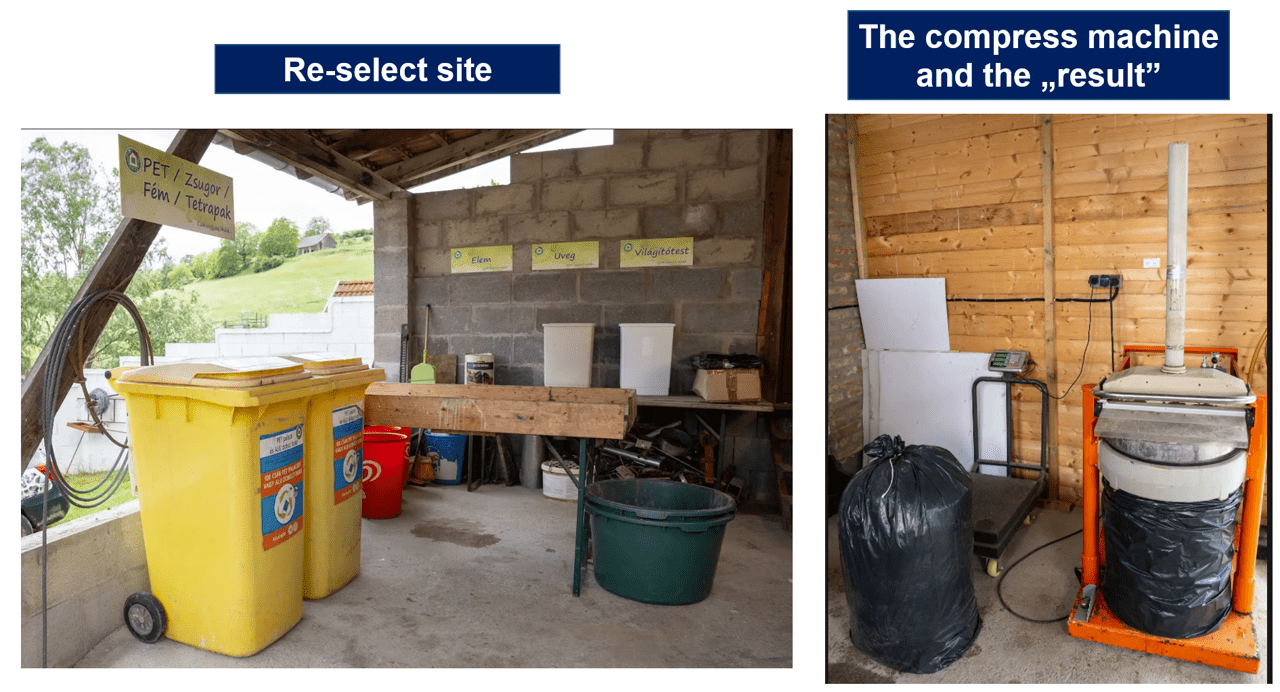
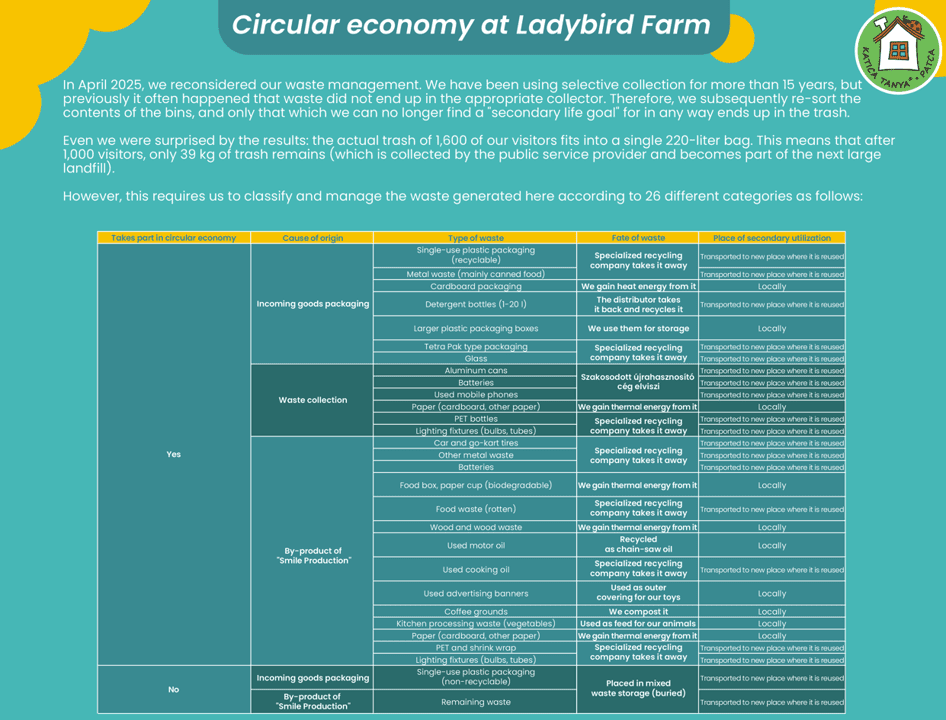
we brought large enough collection containers to the garbage bags and emptied waste into them. Only bags that were already damaged or worn out were discarded. - We re-sorted the collected waste on a specially designed sorting table into 23 different categories, of which only ONE was landfill waste. This means that 22 different material types were guaranteed to find a new „purpose of life” and re-enter the circular economy.
- We purchased a used industrial compactor. The remaining mixed waste is compressed, achieving an average volume reduction of 70–90%.
- The entire system requires only 10–15 minutes of extra work per day.
- We also introduced a new KPI:
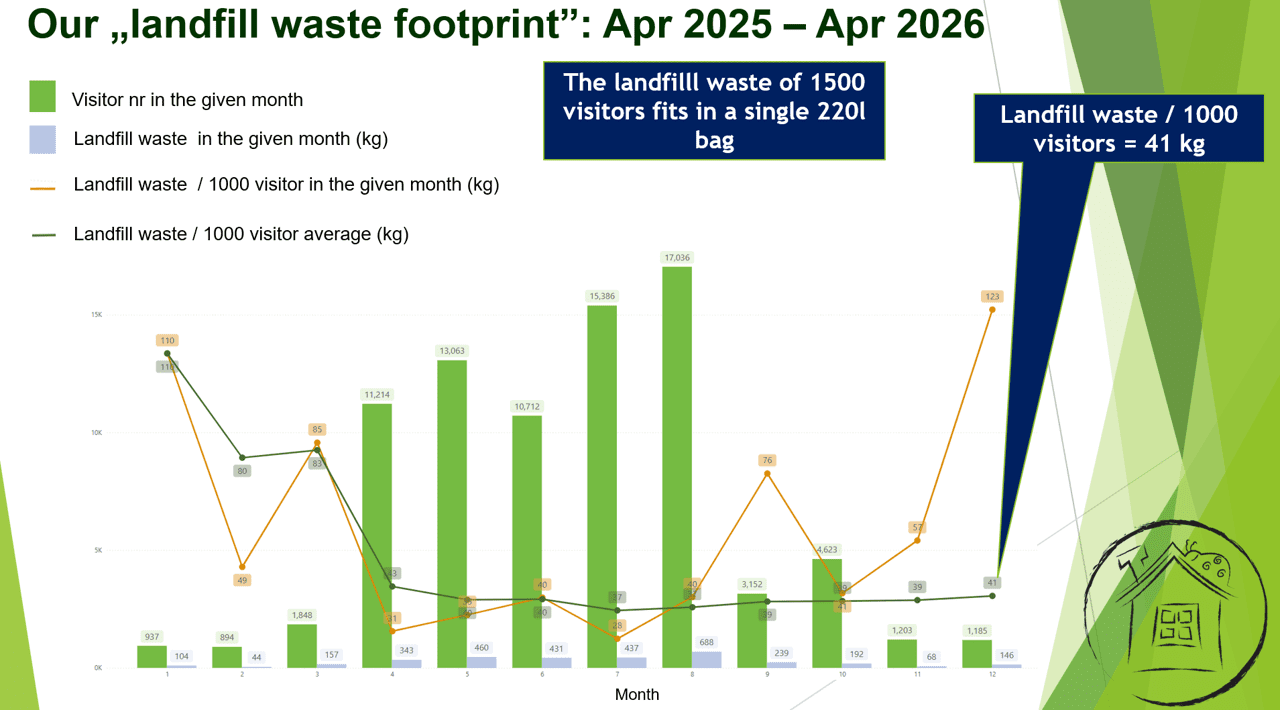
“Landfill waste generated per 1,000 visitors.”
We launched the system last April, and now — one year later — we finally see the full annual results:
- Garbage bag usage decreased by 80%
• Lanfill waste volume decreased by 90%
• Our new KPI reached: 40 kg of waste per 1,000 visitors
The graph below shows the numbers, the 23 waste categories, and a few images of the new process.
Sometimes sustainability does not require expensive miracles.
Sometimes it simply requires questioning old habits.
This process is scalable, can be freely adopted by companies of any size. Like everything else, this also begins with the right mindset….