Energy Crisis and Tightening EU Requirements: Hidden Savings Opportunities in Industrial and Building Operations
Energy Crisis and Tightening EU Requirements: Hidden Savings Opportunities in Industrial and Building Operations
Energy efficiency is no longer merely a sustainability objective; it has become a key factor in corporate competitiveness. The vulnerability of European energy markets, increasingly stringent EU requirements, and decarbonisation efforts are bringing new attention to the modernisation of existing systems. NUXON offers technological solutions that, in many cases, can reduce energy and resource consumption without requiring the complete replacement of existing equipment.
Beyond the Energy Crisis: New Challenges for European Businesses
The energy market developments of recent years have demonstrated the significant business risks associated with fluctuating energy prices and dependence on imported energy.
According to the European Commission’s Affordable Energy Action Plan, presented in February 2025, the proposed measures could generate estimated annual savings of up to EUR 130 billion across the European Union by 2030.
At the same time, energy efficiency requirements are becoming increasingly stringent.
Under the revised Energy Efficiency Directive (EU) 2023/1791, companies with an average annual energy consumption exceeding 10 TJ over the previous three years are, subject to certain conditions, required to undergo energy audits. Companies exceeding 85 TJ must implement a certified energy management system.
The revised Energy Performance of Buildings Directive (EU) 2024/1275 also establishes minimum energy performance requirements targeting the worst-performing non-residential buildings, with milestones in 2030 and 2033, subject to national implementation measures and specified exemptions.
The question facing businesses is therefore becoming increasingly clear: how can existing infrastructure be operated with lower energy consumption and fewer resources?
Savings May Be Hidden Where We Have Not Yet Looked
When considering energy efficiency improvements, attention often turns to new equipment, renewable energy systems, or comprehensive building renovations.
Yet significant opportunities may also lie in optimising industrial and building operation systems that are already in use.
Conventional air filters gradually accumulate contaminants during operation, increasing airflow resistance. Depending on the system design and control strategy, this can lead to higher fan energy consumption. Regular filter replacement also involves continuous material consumption, maintenance activities, and waste generation.
NUXON, the air filtration division of Mielemed MPM Kft., provides advanced electrostatic air filtration solutions that can offer an alternative to conventional filtration technologies under suitable technical conditions.
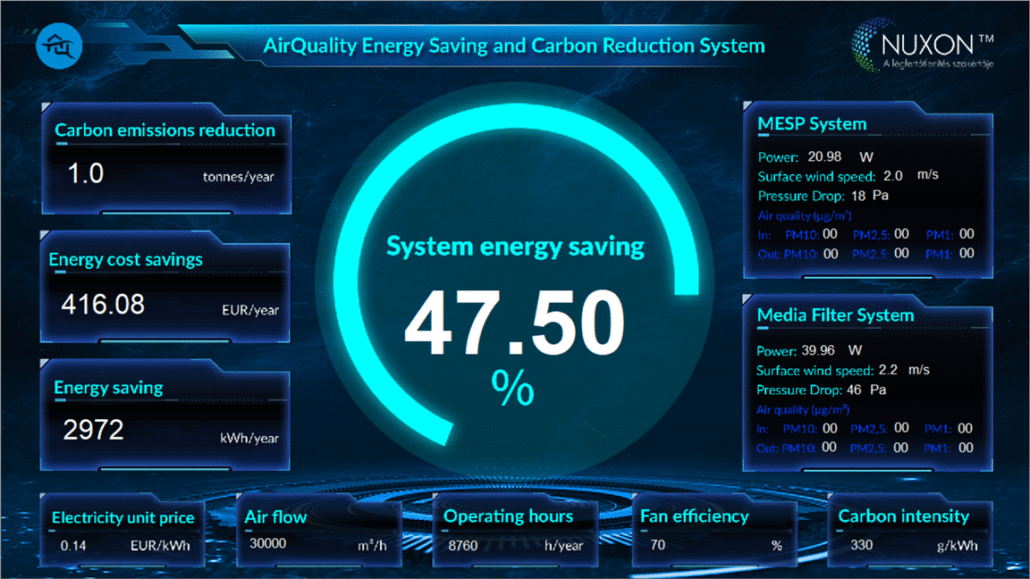
A key element of the portfolio is MESP (Micro-Electrostatic Precipitation) technology, which uses an electric field to capture and remove airborne particles.
Its low pressure drop, combined with washable and reusable filter cells, creates opportunities to reduce energy consumption, filter replacement costs, and waste generation.
Different Industries, Specific Sustainability Challenges
Manufacturing and Industrial Facilities
Targeted removal of dust, fumes, and aerosols generated by industrial processes can help reduce contaminant loads where the technology is technically suitable.
When selecting a filtration solution, energy consumption and ease of maintenance are just as important as filtration performance.
Office Buildings, Commercial Properties, and Service Facilities
Upgrading the filtration systems of existing air handling units can reduce operational energy demand and the consumption of disposable filters, while allowing equipment that remains in good technical condition to continue operating.
Hospitality, Commercial Kitchens, and the Food Industry
Managing grease and oil aerosols, smoke, and odour emissions requires specialised solutions.
Targeted particle removal, combined with appropriate supplementary odour treatment technologies, can contribute to reducing environmental impact.
Energy Efficiency and Building Services Engineering Projects
Reviewing existing filtration systems can reveal additional opportunities for energy efficiency improvements.
A comprehensive assessment of energy consumption, pressure drop, maintenance requirements, and life-cycle costs supports well-informed investment decisions.
The Real Value of Sustainability Lies in Measurable Results
The sustainability benefits of technological upgrades cannot be assessed solely on the basis of technical specifications.
It is essential to consider the initial operating conditions, annual operating hours, actual energy consumption, maintenance and cleaning requirements, and the amount of waste generated.
NUXON’s approach therefore focuses on identifying the modernisation potential of each individual system and selecting solutions that are technically justified.
Sustainable operations do not necessarily mean rebuilding or replacing everything. In many cases, significant progress can be achieved by operating existing systems with less energy, generating less waste, and improving long-term cost efficiency.
NUXON – Innovative Air Filtration Solutions for More Energy-Efficient and Sustainable Operations.
Mielemed MPM Kft. | NUXON Division