As a responsible domestic company, SPAR Hungary is striving to minimise its impact on the environment in both its commercial operations and manufacturing processes, to protect employees and customers, to offer products from an increasing number of small and family-owned Hungarian companies and to pay attention to disadvantaged groups in the spirit of social responsibility. The company spent more than 200 million HUF on charitable causes in 2023.
School supplies donation campaign supports school start for pupils in need
Customers of INTERSPAR hypermarkets contributed to the start of the school year of around 1600 needy students with more than 62 000 pieces of school supplies and nearly 2.2 million HUF worth of donation cards during the third “Joy to Give!” (Adni Öröm!) school supplies collection campaign organised in 2023, in cooperation with the Charity Service of the Hungarian Order of Malta. The retail chain donated a further one million forints on top of the amount raised.
Joy to Give! – shoppers make Christmas happier
For the 27th time, the Charity Service of the Hungarian Order of Malta and SPAR Hungary launched the joint Christmas campaign called “Joy to Give!” (Adni Öröm!) under the motto “Your donation is worth treasures” to raise awareness that even donating a single product can do a lot for our fellow people in need during the festive season. From 1 December, those who wanted to help could support the campaign with donation cards, and from 14 to 19 December, volunteers in the designated stores received the donations of food and sweets for the children. The success of the campaign is clearly demonstrated by the amount of more than 200 tonnes of food products collected, enabling 25 000 gift packages to be made for families in need. Before Christmas, more than 6.3 million HUF was donated through donation cards purchased in the SPAR online shop and in stores, and another 5 million HUF was donated through the adomanyozz.hu website, which was also used to send food gift packages.

Equal Opportunities Run and donation campaign at the SPAR Budapest Marathon Festival
Runners have entered the races from 816 municipalities in Hungary and 93 countries at the SPAR Budapest Marathon Festival, this year also underlined by the fact that the city of Budapest was celebrating its 150th birthday in 2023. The company also celebrated an anniversary last year, as the festival has been the SPAR name for 15 years, expressing the company’s commitment to promoting a health-conscious lifestyle and active sports. The event also served charitable purposes this year, with race entries also supporting charity organisations that joined the fundraising activities of the festival. The 11th FODISZ Equal Opportunities Run was one of the most prestigious events of the two-day festival, where disabled runners and those with limited mobility ran together with young people in solidarity with them, over a symbolic 500-metre distance.
Any saved food matters
SPAR joined the Munch food rescue platform in 2022, which allows shoppers to rescue food that would otherwise be thrown out. After a six-month pilot period, from the summer of 2023, all SPAR and INTERSPAR stores offer customers the opportunity to use the app to get cheaper access to food products with an upcoming expiry date. Even the products not sold in this way will not be lost, as the good quality items are donated to disadvantaged families, the elderly, the sick and the homeless under cooperation with the Charity Service of the Hungarian Order of Malta.
Donations to the Heim Pál Children Hospital
Healthcare is another important area of the company’s charitable initiatives. SPAR Hungary, in cooperation with Intersnack, the manufacturer of Chio and Pom-Bär products, donated 4.6 million HUF to the Heim Pál National Paediatric Institute. The grant was used to improve the hospital’s ear, nose and throat department, with the purchase of surgical equipment that will enable more tonsillectomies to be performed in parallel, so that children will not have to wait long for surgery.
Helping four-legged companions
Every year, SPAR Hungary supports animals in shelters, in partnership with Országos Állatvédőrség Alapítvány (National Animal Rights Foundation), by organising animal food collection campaigns in INTERSPAR stores. In 2023, 174 collection events were made by NGOs in the company’s 33 stores throughout the country. At the events, a total of more than 17 000 cans of dog food, 27 814 bags of cat food, 27 344 kg of dry dog food and 4 645 kg of dry cat food were collected for the pets living in shelters.
In addition to the above, in the fourth edition of the “Paw in Trouble!” (Mancs a Bajban!) campaign, during which more than thirty activists from animal welfare organisations received donations from customers at thirty-five collection points in 2 days. More than 9 000 kg of dry food and 4 500 cans of dog food, as well as more than 1 000 kilograms of dry food, nearly 2 500 cans of canned food, 5 000 cat food packets and 1 355 kg of cat litter were collected for cats.
Planting native fruit trees to reduce carbon footprint
For many years now, SPAR Hungary has consciously strived to operate in an environmentally-conscious way. At this year’s Budapest Wine Festival, SPAR organised its event for business partners in such a way as to minimise carbon footprint: it voluntarily compensated for the emissions generated by the organisation, energy consumption, travel and meals by planting native fruit trees. SPAR has also sought to reduce its environmental footprint by sourcing ingredients for the food served at the event from local producers, and by preparing the meals on site, eliminating the need to package and transport the food separately. Waste was collected selectively, untouched food was distributed to those in need with the help of the Hungarian Food Bank Association, and the remaining waste was transported and processed by Biofilter. The 8.5 tonnes of CO2 emissions from the event, calculated by the GreenDependent Institute, were voluntarily offset by the Hungarian retail chain by planting native fruit trees, thus also contributing to biodiversity and species conservation: 392 saplings were planted in the gardens of educational and welfare institutions.
Local products, growing small enterprises, satisfied customers
With organising the Hungaricool competition, SPAR Hungary has been committed to helping small businesses get their products on the shelves: 179 enterprises entered 301 products for the 2023 competition. The production and INTERSPAR sales of the nine new winning brands and their 37 new products gives jobs to more than a hundred employees including suppliers, and enhances the will to enterprise for others.
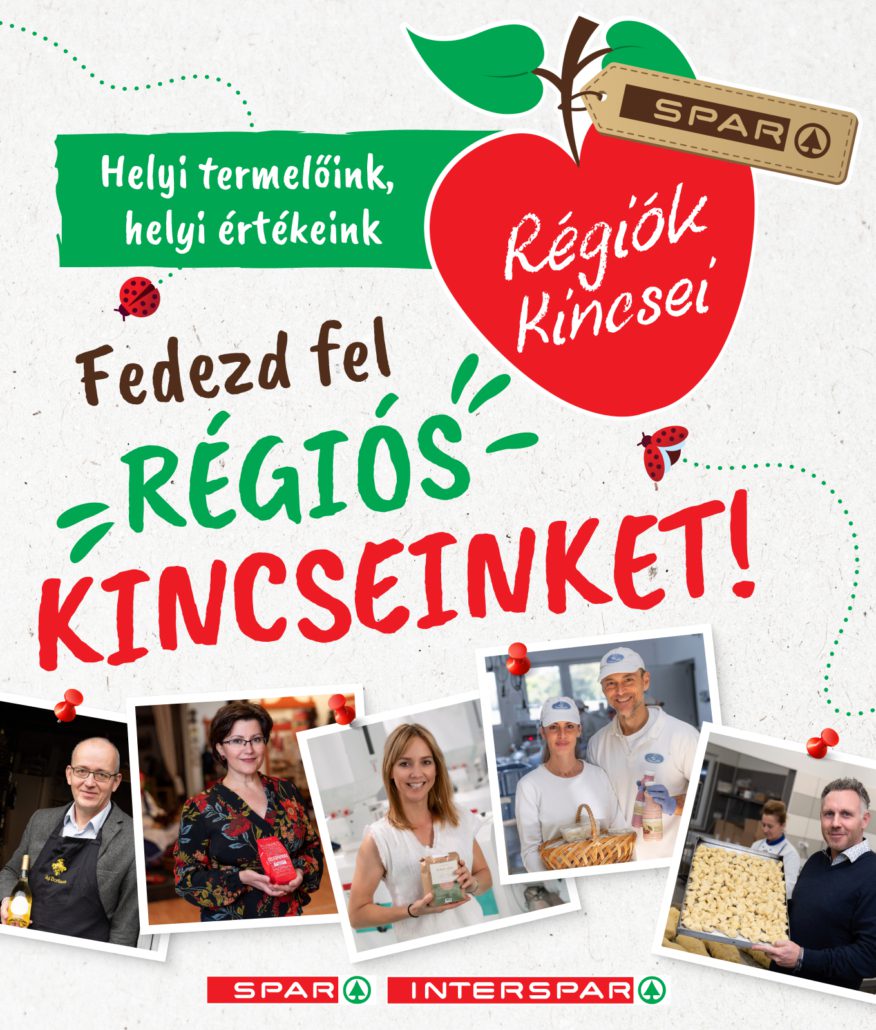
The Regional Treasures (Régiók Kincsei) programme, launched in 2021, also improves market access for small domestic producers. As a first step, the company has set up regional centres in six cities – Nyíregyháza, Pécs, Győr, Székesfehérvár, Zalaegerszeg and Hódmezővásárhely – and from this year, the programme has also made high-quality Hungarian products available of small Hungarian businesses, producers and artisanal companies in Budapest.