• Facebook
  • LinkedIn
  • Mail
  • Magyar Magyar Hungarian hu
  • English English English en
BCSDH
  • About us
    • Mission
      • Vision 2050
      • Management Guidelines
    • Organization
    • Partners
  • Our members
    • Membership
    • List of our members
    • Become a member
  • News
    • Our news
    • Member news
  • Our activities
    • 1. oszlop
      • Time to transform 2030
      • Race to Zero
      • Circular Economy Platform
      • ESG
      • Working groups
    • Future Leaders Program
      • Scholarship
    • For a Sustainable Future Award
    • International projects
      • ERASMUS+ DEDYCATING
      • ISSUE
      • Circular Regions
    • Archive
      • Action 2020
  • Events
    • Events calendar
    • Gallery
  • Resources
    • Business solutions
  • Circular Economy Hotspot 2026
  • Menu Menu
  • About us
    • Mission
      • Vision 2050
      • Management Guidelines
    • Organization
    • Partners
  • Our members
    • Membership
    • List of our members
    • Become a member
  • News
    • Our news
    • Member news
  • For a Sustainable Future Award
  • Our activities
    • Time to transform 2030
    • Race to Zero
    • Circular Economy Platform
    • ESG
    • Working groups
    • Future Leaders Program
      • Scholarship
    • International projects
      • ISSUE
      • Circular Regions
    • Archive
      • Action 2020
  • Resources
    • Business solutions
  • Events
    • Events calendar
    • Gallery
  • Circular Economy Hotspot 2026
You are here: Home1 / News2 / Regisztráció – „A jövő vezetői” Alumni program tavaszi esemény3 / 20264 / April

While we should approach it with a critical eye, artificial intelligence is also a useful tool for ESG

News

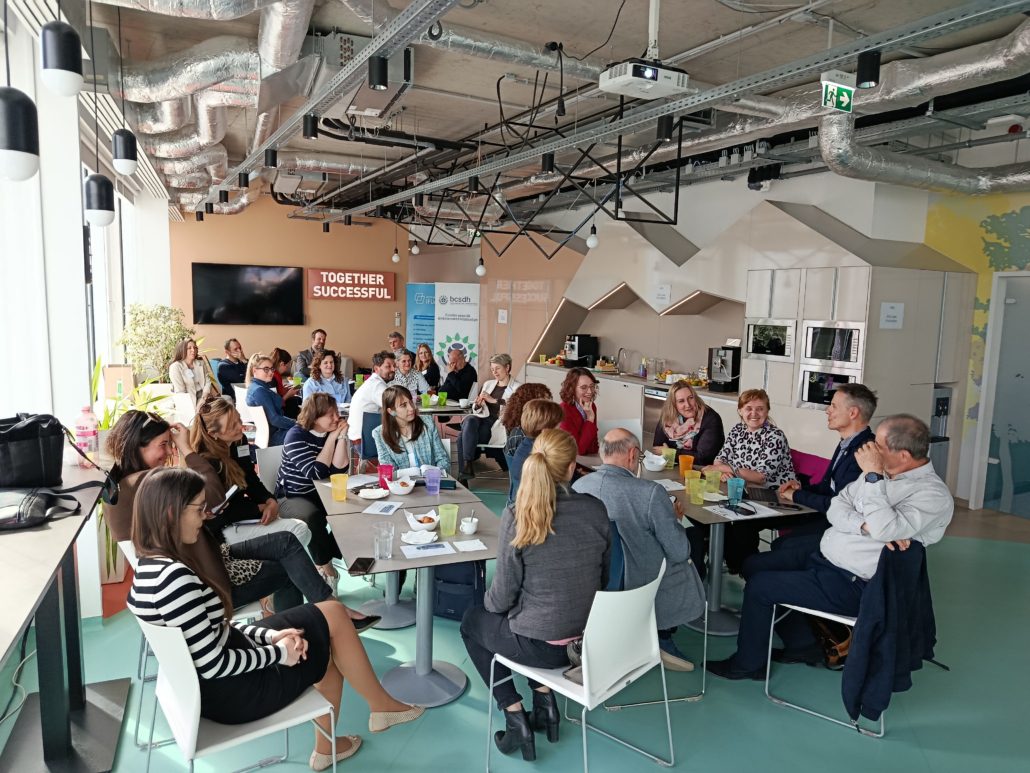
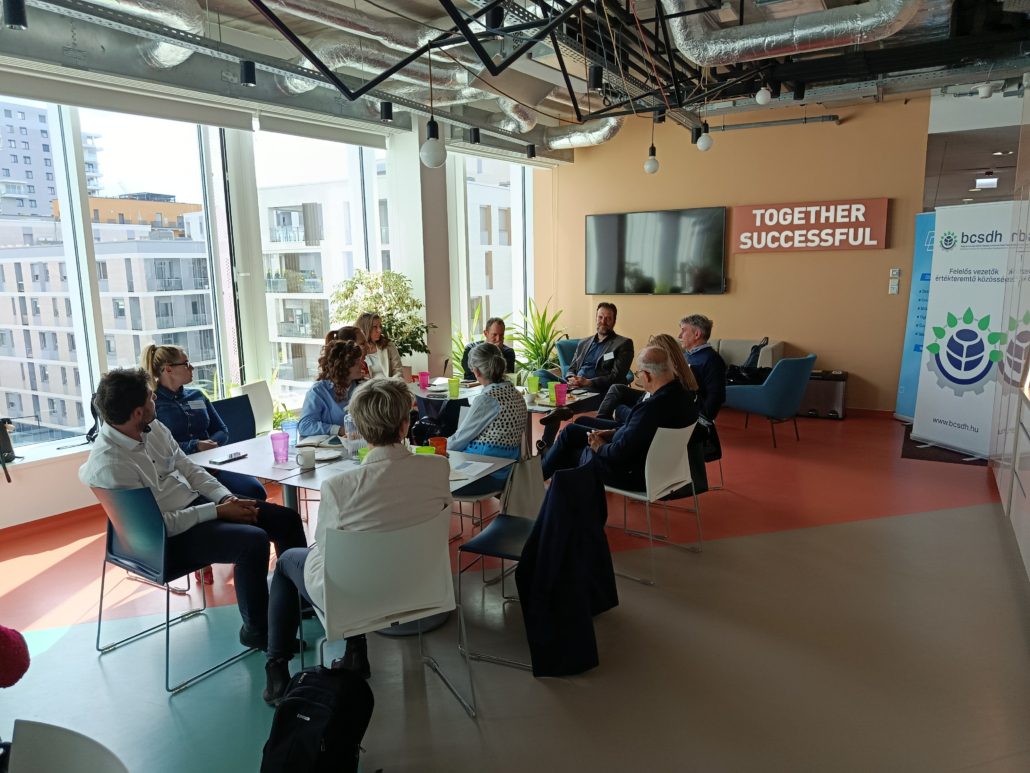
On April 21, 2026, we held the latest meeting of the Business Council for Sustainable Development in Hungary (BCSDH) ESG Working Group at the IFUA Horváth, which focused on the connections between artificial intelligence, sustainability, and ESG.

The development of artificial intelligence has brought significant changes to the field of ESG management and reporting as well, noted Dr. Viktória Bodnár, managing director of IFUA Horváth, in her opening remarks. She emphasized that sustainability management must become more digital, integrated, and strategic.

In her presentation, Nóra Stancsics, Principal at IFUA Horváth, focused on the potential of AI to support ESG management and reporting. She pointed out that digitalization and efficiency have become expectations in these areas as well. The application of AI – from data collection through narrative development to analysis – can provide significant support in complex ESG reporting processes; however, the conscious and controlled use of technology is essential for risk management.

Anita Kopcsó, a senior manager at EY, then presented the concept of the BCSDH’s new Digital and AI Working Group. The initiative aims to explore the impact of AI and digitalization on corporate operations and sustainability performance, while supporting member companies through practical examples and experiences. In her presentation, she noted that digitalization can lead to significant efficiency gains, but the direction of its sustainability impacts requires further investigation.

Irén Márta, Director of BCSDH, briefly introduced the Dedycating project, which aims to develop methodological tools that enable the use of artificial intelligence for the dynamic development of curricula and the creation of sector-specific learning materials.

To conclude the program, participants shared their own experiences with AI applications in the ESG field during small-group discussions, with a particular focus on opportunities and emerging challenges. The groups identified several areas in the corporate use of AI that raise numerous questions. These include data security, the organization of management processes, creativity, and the need for critical thinking.

Thanks to our sponsors!

22.04.2026
https://bcsdh.hu/wp-content/uploads/2026/04/IMG_20260421_140728-scaled.jpg 1920 2560 Galambosne Dudas Zsofia https://bcsdh.hu/wp-content/uploads/2021/12/bcsdh-logo.png Galambosne Dudas Zsofia2026-04-22 20:18:082026-04-22 20:18:08While we should approach it with a critical eye, artificial intelligence is also a useful tool for ESG

Flexible energy solutions for sustainable and predictable operations

Member News

The functioning of energy markets is increasingly shaped not only by economic factors but also by geopolitical developments. Global events are rapidly and directly reflected in European energy prices, resulting in sustained volatility and market movements that are difficult to predict. In this environment, the role of energy is also evolving: for companies, it is no longer merely a cost factor, but a strategic resource that directly influences operations and competitiveness.

E.ON Hungária Group aims to support its customers in adopting a more conscious and forward-looking approach to energy procurement, even in a constantly changing market environment. The Group offers solutions that enable customers to tailor their energy strategies to their specific operations and needs, while remaining flexible in response to market developments.

Sustainability has become an integral part of energy procurement. Companies are placing increasing emphasis on ensuring that their energy consumption meets not only economic but also environmental expectations. In line with this, E.ON provides solutions that support a higher share of renewable energy in supply portfolios and contribute to the achievement of corporate sustainability goals.

Flexible contractual structures – including fixed-price and market-based solutions, as well as their combinations – allow companies to balance cost considerations with operational flexibility. The development of a conscious energy strategy increasingly depends on timing, contractual design, and the appropriate combination of available solutions.

Digitalisation is also becoming a key enabler: time-based tariffs built on smart metering data allow for more precise consumption planning and more effective utilisation of market opportunities. This type of flexibility is particularly valuable in an environment characterised by rapidly changing prices.

When designing contractual structures, adapting to market conditions becomes a priority. E.ON offers agreements across different time horizons, enabling customers to choose solutions that best fit their operations—whether prioritising short-term flexibility or longer-term predictability.

As the energy market continues to evolve, the role of the energy trader is also transforming. Beyond ensuring supply, increasing emphasis is placed on informed planning and decision support. In this context, flexible energy supply is not merely a tool, but a key enabler of predictable, responsible and sustainable long-term operations.

21.04.2026
https://bcsdh.hu/wp-content/uploads/2022/07/E.ON_RGB_Red.png 595 842 Gyurgyik Anna https://bcsdh.hu/wp-content/uploads/2021/12/bcsdh-logo.png Gyurgyik Anna2026-04-21 12:35:402026-04-21 12:35:53Flexible energy solutions for sustainable and predictable operations

Greater transparency, fewer misconceptions in the energy storage market

Member News

ALTEO is launching a free, online report that provides operators, owners, and prospective investors in energy storage with real, first-hand data on potential returns.

The objective is clear: to help dispel misconceptions and uncertainties surrounding energy storage, and to support well-informed decision-making in a rapidly evolving market environment.

The market is constantly changing—making it especially important that decisions are based on up-to-date, real-world data.

The full report is available on ALTEO’s website.

21.04.2026
https://bcsdh.hu/wp-content/uploads/2025/09/ALTEO_450.jpg 450 450 Gyurgyik Anna https://bcsdh.hu/wp-content/uploads/2021/12/bcsdh-logo.png Gyurgyik Anna2026-04-21 11:54:062026-04-21 11:54:06Greater transparency, fewer misconceptions in the energy storage market

ALTEO’s energy storage capacity has expanded significantly

Member News

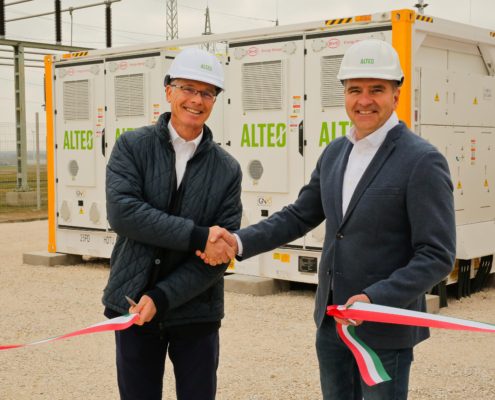
The unit inaugurated in Győr, with a capacity of nearly 100 MWh and a power output of 49.9 MW, is currently Hungary’s largest industrial energy storage facility, accounting on its own for approximately 20% of the country’s total storage capacity. With the commissioning of the fifth lithium-ion storage unit in Bana—featuring 10 MW power and 20 MWh capacity—ALTEO’s total energy storage capacity has increased to 80 MW.

In the field of energy storage, the primary challenge today is no longer the technology itself, but how to operate available capacities efficiently within a market environment. In recent years, ALTEO has built its own digital production management and optimization solutions around this challenge, enabling it to efficiently manage not only its own assets but also the portfolios of its partners.

The new units are connected to ALTEO’s VPP, allowing them to actively participate in the flexibility and balancing processes of the domestic electricity market.

21.04.2026
https://bcsdh.hu/wp-content/uploads/2025/09/ALTEO_450.jpg 450 450 Gyurgyik Anna https://bcsdh.hu/wp-content/uploads/2021/12/bcsdh-logo.png Gyurgyik Anna2026-04-21 11:49:382026-04-21 11:51:27ALTEO’s energy storage capacity has expanded significantly

Successful PICASSO accreditation at ALTEO

Member News

ALTEO has successfully completed MAVIR’s aFRR accreditation tests, thereby meeting the prerequisite for joining the PICASSO platform. As of October 1, 2026, the company will be able to provide balancing services not only domestically but across nearly the entire continent.

During the accreditation process, one of Hungary’s largest regulation capacities—comprising several hundred MWs and integrating both conventional and renewable generation—was successfully tested. In addition to ALTEO’s own power plants, solar facilities operating under KÁT, METÁR, and merchant market schemes from long-standing partners also contributed significant capacity to the accreditation.

21.04.2026
https://bcsdh.hu/wp-content/uploads/2025/09/ALTEO_450.jpg 450 450 Gyurgyik Anna https://bcsdh.hu/wp-content/uploads/2021/12/bcsdh-logo.png Gyurgyik Anna2026-04-21 11:46:152026-04-21 11:46:15Successful PICASSO accreditation at ALTEO

Green transition is not a sprint, but a marathon.

Member News

Attila Chikán Jr., CEO of ALTEO, is a contributing author to the publication GREEN ECONOMY 2026 – the third edition of the Hungarian Association of Environmental Enterprises’ landmark study.

His article examines the industry and system-level issues shaping the sustainable transformation of Hungary’s electricity system, with particular focus on balancing sustainability, security of supply, and affordability. Global demand for electricity is growing at an unprecedented pace, while the expansion of renewable-based generation is bringing increasingly complex technical, grid-related, and regulatory challenges to the forefront.

The article also highlights that the stable long-term operation of the electricity system can only be ensured through a diversified asset portfolio, flexible reserves, and data-driven, intelligent control.

The GREEN ECONOMY 2026 publication can be downloaded via the link after providing personal details.

21.04.2026
https://bcsdh.hu/wp-content/uploads/2025/09/ALTEO_450.jpg 450 450 Gyurgyik Anna https://bcsdh.hu/wp-content/uploads/2021/12/bcsdh-logo.png Gyurgyik Anna2026-04-21 11:42:382026-04-21 11:42:38Green transition is not a sprint, but a marathon.

Environmental, social and governance factors must also be considered in banks’ corporate governance and risk management systems

Member News

The Magyar Nemzeti Bank (MNB) has renewed its green banking recommendation, incorporating the European Banking Authority’s guidelines on the management of ESG risks, while retaining several domestic expectations that go beyond EU requirements. The new recommendation applies to domestic credit institutions, including third-country credit institution branches and licensed investment service providers. As for its entry into force, it will be implemented in two phases: from 1 July 2026, large and complex institutions will fall under its scope, while from 1 January 2027, the supervisory expectations set out in the green banking recommendation will also enter into force for the other market participants covered by recommendation.

The document in Hungarian can be found here.

21.04.2026
https://bcsdh.hu/wp-content/uploads/2022/01/MNB.png 170 450 Gyurgyik Anna https://bcsdh.hu/wp-content/uploads/2021/12/bcsdh-logo.png Gyurgyik Anna2026-04-21 11:28:182026-04-21 11:28:18Environmental, social and governance factors must also be considered in banks’ corporate governance and risk management systems

EU Pay Transparency Directive: obligations and actions for companies

Member News

The EU Pay Transparency Directive (2023/970) introduces new obligations for employers, particularly regarding the disclosure of pay gaps, salary information in job postings and employee information rights. Member States must transpose the directive by 7 June 2026. As a result, companies need to review their compensation systems, HR processes and internal policies.

This guide explains who is affected by pay transparency, what obligations companies face, and what concrete steps are required to ensure compliance.

What does pay transparency mean in practice?

  • mandatory disclosure of salary ranges in job advertisements
  • regular reporting on the gender pay gap
  • employees’ right to request pay information
  • implementation of objective and gender-neutral pay systems

What should employers know about pay transparency?

The objective of the Pay Transparency Directive is to strengthen the principle of “equal pay for equal work” and reduce gender pay gaps. Member States must transpose the Directive into national law by 7 June 2026.

For companies, pay transparency primarily introduces changes in the following areas:

  • regular reporting obligations on the gender pay gap
  • joint pay assessments with employee representatives in certain cases
  • the development and communication of transparent salary bands
  • the application of data-driven HR analytics
  • more structured leadership communication around remuneration

Pay transparency therefore represents not a single HR process, but the coordinated functioning of several organisational areas.

The following summary presents the key insights from our six-part article series.

How will pay transparency be implemented in Hungary?

The Pay Transparency Directive introduces new tools to increase transparency in remuneration systems. Among other elements, the regulation requires:

  • the communication of salary ranges in job advertisements or during the recruitment process
  • the prohibition of questions about previous salary
  • regular measurement and reporting of the gender pay gap
  • joint pay assessments in certain situations

The Hungarian implementation is expected to affect several areas simultaneously, including:

  • the Labour Code
  • equal treatment regulations
  • data protection practices

For employers, pay transparency therefore represents primarily an integrated HR and legal challenge.

Read more about the expected Hungarian implementation: 

Pay transparency part 1: Where does Hungarian implementation stand?

What reporting obligations apply to companies?

One of the key elements of the Directive is the regular analysis and reporting of the gender pay gap.

Companies will be required to report, among other indicators:

  • the average and median gender pay gap
  • differences in variable remuneration
  • the proportion of women and men across job categories

If the pay gap within a given employee category exceeds a defined threshold and cannot be explained by objective factors, the employer must conduct a joint pay assessment with employee representatives.

In practice, this means a comprehensive review of the compensation system, including:

  • job requirements
  • salary bands
  • performance evaluation systems
  • promotion practices

Read more about reporting obligations and joint pay assessment: 

Pay transparency part 2: Joint pay assessment and reporting obligations in practice

How can companies prepare for pay transparency?

A key condition for implementing pay transparency is the establishment of a clear and consistent job architecture.

Its main components include:

  • defined job families and career levels
  • standardised job descriptions
  • objective classification principles

These provide the basis for job evaluation systems and salary band structures that determine the appropriate remuneration range for each position.

In international practice, a readiness audit is increasingly used to assess how prepared an organisation is for the requirements of pay transparency.

Read more about readiness audits:

Pay transparency part 3: Readiness audit for Hungarian employers

How can gender pay gaps be measured?

One of the most important elements of pay transparency is the proper analysis of pay data.

Gender pay gaps are typically analysed on two levels:

Unadjusted pay gap
The simple difference between the average pay of men and women.

Adjusted pay gap
A statistical analysis that controls for factors such as job role, experience or location.

These analyses are not only required for compliance purposes but also support leadership decision-making.

Many organisations increasingly rely on dashboards and HR analytics tools to monitor compensation structures and identify potential risk areas.

Read more about pay equity analysis:

Pay transparency part 4: What do the data show?

What should be communicated to employees?

Communication is one of the most sensitive aspects of pay transparency.

The Directive introduces information obligations on three levels:

  • towards authorities, through gender pay gap reporting
  • towards employees, through regular information on pay equity
  • on an individual level, when employees request information about their own pay and comparable roles

Effective communication helps prevent misunderstandings and maintain organisational trust.

Read more about communication requirements:

Pay transparency part 5: What, when and how must be communicated?

What is the role of leadership in pay transparency?

Ultimately, pay transparency becomes visible in everyday leadership conversations.

Typical employee questions often focus on:

  • how salary bands work
  • what determines placement within a band
  • why differences exist between teams or roles

Leaders must be prepared to answer these questions consistently and based on objective criteria.

Typical leadership questions and response frameworks:

Pay transparency part 6: Consistent leadership responses

Pay transparency as an opportunity for organisational development

Although pay transparency is primarily introduced as a regulatory obligation, it can also represent a broader organisational development opportunity.

Transparent salary structures, data-driven HR decisions and consistent communication can help organisations:

  • strengthen employee trust
  • improve retention
  • create more predictable and transparent operations

If you would like to assess how prepared your organisation is for the requirements of pay transparency, our experts can support you with readiness audits, job architecture design and compensation structure reviews.

21.04.2026
https://bcsdh.hu/wp-content/uploads/2026/04/gt_logo.webp 475 1730 Gyurgyik Anna https://bcsdh.hu/wp-content/uploads/2021/12/bcsdh-logo.png Gyurgyik Anna2026-04-21 11:19:062026-04-21 11:19:42EU Pay Transparency Directive: obligations and actions for companies

Greenbors = BREEAM Market Leader in Hungary

Member News

Greenbors further strengthened its market-leading position in Hungary’s rapidly growing BREEAM certification market in 2025. The year 2025 proved to be a milestone in the history of sustainable architecture and certification systems in Hungary. An analysis of the latest Market Snapshot reveals a trend that is particularly important to us at Greenbors Consulting: the meeting of demand for expertise and quality.

Read more

21.04.2026
https://bcsdh.hu/wp-content/uploads/2022/01/greenbors-consulting.png 170 450 Gyurgyik Anna https://bcsdh.hu/wp-content/uploads/2021/12/bcsdh-logo.png Gyurgyik Anna2026-04-21 10:59:572026-04-21 10:59:57Greenbors = BREEAM Market Leader in Hungary

Green Light for Sustainable Real Estate: MNB Program Extended and Expanded

Member News

In recent years, it has become clear that sustainability is no longer merely a reputational issue in the real estate market; it is increasingly a defining factor in financing viability, asset value, and long-term competitiveness. Demand from both investors and tenants for green-certified or ESG-compliant properties is on the rise, while financiers are also showing a growing preference for projects that meet sustainability expectations.

Read more
21.04.2026
https://bcsdh.hu/wp-content/uploads/2022/01/greenbors-consulting.png 170 450 Gyurgyik Anna https://bcsdh.hu/wp-content/uploads/2021/12/bcsdh-logo.png Gyurgyik Anna2026-04-21 10:57:112026-04-21 10:57:11Green Light for Sustainable Real Estate: MNB Program Extended and Expanded
Page 1 of 212
Followon TwitterSubscribeto RSS Feed

Latest news

Categories

  • Award
  • Business Solution Award
  • Business Transformation award
  • Change Leader Award
  • Kiemelt hírek
  • Leading women award
  • Member News
  • New member
  • News
  • új tagvállalat
  • Uncategorized

Archives

  • April 2026
  • March 2026
  • February 2026
  • January 2026
  • December 2025
  • November 2025
  • October 2025
  • September 2025
  • August 2025
  • July 2025
  • June 2025
  • May 2025
  • April 2025
  • March 2025
  • February 2025
  • January 2025
  • December 2024
  • November 2024
  • October 2024
  • September 2024
  • August 2024
  • July 2024
  • June 2024
  • May 2024
  • April 2024
  • March 2024
  • February 2024
  • January 2024
  • December 2023
  • November 2023
  • October 2023
  • September 2023
  • August 2023
  • July 2023
  • June 2023
  • May 2023
  • April 2023
  • March 2023
  • February 2023
  • January 2023
  • December 2022
  • November 2022
  • October 2022
  • September 2022
  • August 2022
  • July 2022
  • June 2022
  • May 2022
  • April 2022
  • March 2022
  • February 2022
  • January 2022
  • December 2021
  • November 2021
  • October 2021
  • September 2021
  • August 2021
  • July 2021
  • June 2021
  • May 2021
  • April 2021
  • March 2021
  • February 2021
  • January 2021
  • December 2020
  • November 2020
  • October 2020
  • September 2020
  • July 2020
  • June 2020
  • May 2020
  • April 2020
  • March 2020
  • February 2020
  • January 2020
  • December 2019
  • November 2019
  • October 2019
  • September 2019
  • August 2019
  • July 2019
  • June 2019
  • May 2019
  • April 2019
  • March 2019
  • February 2019
  • January 2019
  • December 2018
  • November 2018
  • October 2018
  • September 2018
  • August 2018
  • July 2018
  • June 2018
  • May 2018
  • April 2018
  • February 2018
  • January 2018
  • December 2017
  • November 2017
  • October 2017
  • September 2017
  • May 2017
  • April 2017
  • March 2017
  • February 2017
  • December 2016
  • November 2016
  • October 2016
  • September 2016
  • August 2016
  • July 2016
  • June 2016
  • May 2016
  • April 2016
  • March 2016
  • February 2016
  • December 2015
  • November 2015
  • October 2015
  • September 2015
  • August 2015
  • July 2015
  • June 2015
  • April 2015
  • March 2015
  • February 2015
  • January 2015
  • December 2014
  • November 2014
  • October 2014
  • September 2014
  • August 2014
  • July 2014
  • June 2014
  • May 2014
  • April 2014
  • March 2014
  • February 2014
  • January 2014
  • December 2013
  • November 2013
  • September 2013
  • July 2013
  • June 2013
  • May 2013
  • April 2013
  • March 2013
  • February 2013
  • January 2013
  • November 2012

Business Council for Sustainable Development in Hungary
1118 Budapest, Ménesi street 9/a.

About us
Our mission
Our vision
Our Members
Annual Report
Contact

Carbon-aware events
Gallery

Policies and statements
Privacy policy
Competition Law Statement
Code of Ethics

World Business Council for Sustainable Development (WBCSD) National Partner

© Copyright - BCSDH - powered by Enfold WordPress Theme
  • Facebook
  • LinkedIn
  • Mail
Scroll to top