The World Business Council for Sustainable Development (WBCSD) and more than 40 of its members, all major global companies, lay out “Vision 2050: Time to Transform”, with nine pathways to action across industries to ensure a more sustainable and prosperous future.
The world faces three critical challenges: the climate emergency, nature loss and mounting inequality. The COVID-19 pandemic has illustrated that these challenges are interconnected, and that our systems are ill-prepared for shocks. As global risks continue to build, business leaders are rallying behind a bold and urgent transformation agenda developed by the World Business Council for Sustainable Development (WBCSD), a CEO-led organization of over 200 leading companies.
Vision 2050: Time to Transform sets a shared vision of a world in which more than 9 billion people are able to live well, within planetary boundaries, by 2050. To achieve this vision, we need transformation at scale, and business needs to focus its actions on the areas through which it can best lead the systems transformations.
 Vision 2050: Time to Transform maps how systems transform and lays out a new framework to guide business action in the decade ahead. At the heart of this framework are nine transformation pathways – actionable routes for companies to take – covering the areas of business activity that are essential to society: energy; transportation and mobility; living spaces; products and materials; financial products and services; connectivity; health and wellbeing; water and sanitation; and food.
The vision and transformation pathways are aligned with the Sustainable Development Goals (SDGs) and the targets of the Paris Agreement. Each of the nine transformation pathways contains ten action areas for the decade ahead, designed to help companies drive transformative change in their strategies, business operations and impact on society.
To move beyond business-as-usual into the accelerated transformations necessary, business leaders must adopt three mindset shifts: reinventing capitalism that rewards true value creation; focusing on building long-term resilience; and taking a regenerative approach beyond doing no harm.
While business can take a leading role, it must work on and design systems transformations, together with scientists, policy makers, financiers and investors, innovators and consumers. Only collaboration at unprecedented levels will create the impact and speed needed to achieve all people living well within planetary boundaries by 2050.
“Vision 2050: Time to Transform should not be read with the idea that tomorrow is going to be much the same as today. This is a report for change, starting now, outlining how business needs to play a leading role. We have no time to waste. Achieving this vision requires a wholesale transformation of everything we have grown up with: energy needs to decarbonize; materials need to go circular; food needs to be produced sustainably and equitably and provide healthy diets”, said WBCSD President and CEO Peter Bakker. “Our future depends on transformation. One of the keys to success will be a mindset shift around capitalism. Our economic systems, incentives, global accounting standards and capital market valuations can no longer just be based on the financial performance of businesses: we must integrate our impact on people and planet as part of how we define success and determine enterprise value.”
The report’s foreword, signed by 42 top executives from WBCSD member companies, makes a collective call to global business, stressing: “Business can lead. Business can forge the collaborations required to drive change. It can… but more than that, it must. It is in business’s interest to pursue the transformations set out in Vision 2050 – because its long-term success depends on thriving societies to trade with, and a healthy planet for us all to exist on.”
The launch of Vision 2050 follows the announcement in October 2020, that WBCSD, together with members, raised the bar of business commitment to sustainability through a set of new criteria put forward as part of WBCSD’s membership conditions. The new criteria also focus on the top three priority sustainability challenges that our society faces: climate emergency, nature loss and inequality.
Additionally, WBCSD expects its member companies to strive to the highest standards in corporate governance and transparency, aimed at enhancing the comparability of data for investors and other stakeholders. Over the coming months and years, WBCSD will continue working together with its members and partners to realize the required transformations and “getting sustainability done”.
For more information, please visit our dedicated Vision 2050 website.
—- Quotes from global business leaders —-
“We find ourselves at a time in history where an aspirational, shared vision is more important than ever before to accelerate the transition to a more sustainable future. To transition towards and achieve truly sustainable development we need a clear picture of where we want to go, and a path to set out on. Through Vision 2050, WBCSD member companies have come together to reset the baseline for business leadership for the decade to come.”
Sunny Verghese, Olam – Co-Founder and Group CEO, Olam International & WBCSD Chair
“Running our businesses well into the future requires us to shift the way we think about business resilience. Vision 2050 underlines how companies must recognize that they are only as resilient as the ecosystems, communities, economies, and societies they operate in, and that true resilience isn’t about withstanding change but instead embracing it.”
Keryn James – Group CEO, ERM
“A real step-change, beyond incremental improvements, is needed to transform society and achieve a more sustainable future, in line with the Paris Agreement. Achieving transformation requires a ramping up of ambition and action among all companies, whether they operate within the energy, healthcare, food, finance, transport or other systems. WBCSD’s Vision 2050 identifies the pathways for each of these systems to deliver wholescale-transformation.”
Remi Eriksen, Group President and CEO, DNV AS
“The COVID-19 pandemic has brought vulnerabilities to the surface, underscoring just how fragile and interdependent many of our most vital systems are. Despite its enormous human and financial cost, the pandemic has also created an opportunity to drive and accelerate change at a completely different pace. We now have a unique but rapidly closing window of opportunity for action – it is time to transform our businesses and societies.”
Nadir Godrej – Managing Director, Godrej Industries Limited
“Vision 2050: Time to Transform provides the business community with a uniquely comprehensive and collective understanding of the business actions needed to support the transformations the world needs. It will now take courage and resilience from us all to make this vision a reality.”
Andrea Álvares – Chief Brand, Innovation, International and Sustainability Officer, Natura
“To lay the foundations for a truly prosperous world for people and planet by 2050, we need to address climate change and employ a truly regenerative mindset. That means thinking and acting systemically and restoring critical environmental and social systems that are in decline.”
Magdi Batato – Executive Vice President, Head of Operations, Nestlé
“Market economies have the potential to help to address the most profound challenges faced by our societies and by our planet. But this requires fundamental change. Our economic and business models, which are designed to deliver financial performance as a priority, must urgently change so that they also address the needs of broader stakeholders and environmental sustainability. Vision 2050 is an important contribution to highlight how this can happen.”
Colm Kelly – Global Leader, Purpose, Policy and Corporate Responsibility, PwC
“WBCSD’s Vision 2050 and its framework for how we can collaboratively build a world in which more than 9 billion people live well, serve as a powerful guiding star for the global business community. It makes clear that this vision is still within reach—but we have to come together and act faster. The decade ahead of us is critical and every day offers the opportunity to drive impact.”
Gayle Schueller – Vice President and Chief Sustainability Officer, 3M
“As we emerge from the pandemic, it is clear the world has changed. We are all responsible for taking actions that will address the critical challenges of the climate emergency, nature loss and mounting inequality we are currently facing. The nine pathways of Vision 2050 will galvanize business to take bold steps that will make a tangible difference to our planet, our people and our communities.”
Dominic Blakemore, CEO, Compass Group PLC
“Vision 2050 – Time to Transform provides specific objectives and pathways to implement strategies and action on sustainable development. Action is the best way to release a manifesto – business takes action, makes progress with stakeholders, and contributes to sustainable development actively.”
Yaofeng Cao, Board Director of Sinopec Corp. & Vice President of China Petrochemical Corp
WBCSD member companies that engaged in the development of Vision 2050: Time to Transform were:
3M, ACCIONA, Arcadis, ArcelorMittal, BASF, Bayer, Chanel, DNV, DSM, EDF Group, ENGIE, ERM, EY, Fujitsu, Givaudan, Godrej Industries, Henkel, IFF, Inter IKEA Group, Microsoft Corporation, Mitsubishi Corporation, Natura, Neste Corporation, Nestlé, Olam International, PwC, Rabobank, Banco Santander, Shell, Sompo Japan Insurance Inc., SONAE, Syngenta, The Navigator Company, Toyota Motor Corporation, Unilever, Vale, Volkswagen, and Yara.






 Peter Bakker


 “Five years ago, by adopting the Paris Agreement, our countries committed to decreasing their greenhouse gas emissions but it was only the beginning. The urgency remains and it’s up to us, governments, private companies and citizens to turn these commitments into reality. This is our shared responsibility!” – French Ambassador Pascale Andréani said in her closing remarks.
 “Fighting climate change, climate protection is teamwork. Our common goal is to achieve climate neutrality by 2050, where all contributions count. Renewables are taking over in the power sector in Europe. Next steps in energy transition: replace fossil fuels in transport, industry and heating. Hydrogen will play a crucial role” – German Ambassador Johannes Haindl said. Germany holds the rotating presidency of the European Union from 1 July 2020 which sets the standard for achieving climate neutrality.
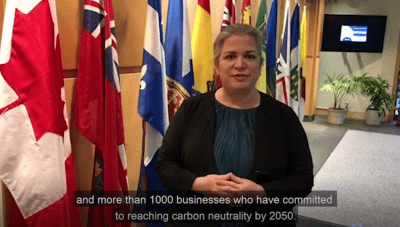 “We are proud to be collaborating with the British Embassy and our other partners on the Race to Zero Business Ambitions Forum and working for a carbon neutral world by 2050. Climate change is a global problem and it will take a coordinated response to find global solutions. Canada continues its work to reduce emissions and build resilient communities and a low carbon economy, knowing the strong connection such efforts have with long-term health and financial well-being.” – Canadian Ambassador Caroline Charette said in her closing remarks.
 “The Netherlands deems climate actions very timely and important that is why it will host the Climate Adaptation Summit on 25 January 2021, focusing on how we can adapt globally to the changing climate and what solutions need to be scaled up further. Please, join this on-line event which will mobilise governments, companies, organisations and citizens worldwide in order to set out a roadmap towards a climate-resilient future by 2030!” – Dutch Ambassador René van Hell said.


