Budapest, January 18, 2021: The Net Zero Advisory Board has been formed in a uniquely wide collaboration with renowned experts, the primary goal of which is to promote and accelerate the process by which the Hungarian economy can become carbon neutral by 2050, thus taking an important step to stop climate change.
The Advisory Board is a cross-sectoral collaboration, consisting of representatives of Hungarian industry and business leaders, chambers of commerce and associations, was set up as the initiative of the British Embassy and the Hungarian Business Council for Sustainable Development (BCSDH).
Members of the Net Zero Advisory Board:
Zsombor Barta (HUGBC – Hungary Green Building Council)
Dr. Gábor Bartus (NCSD – National Council for Sustainable Development)
Attila Chikán Jr. (BCSDH – Business Council for Sustainable Development in Hungary)
Paul Fox (British ambassador)
Anikó Juhász (Ministry of Agriculture)
Csaba Kőrösi (Directorate for Environmental Sustainability of the Office of the President)
Marcell Kovács (MLBKT – Hungarian Association of Logistics, Purchasing and Inventory Management)
Prof. Dr. Diána Ürge-Vorsatz (IPCC –Intergovernmental Panel on Climate Change, HUPCC- Hungarian Panel on Climate Change)

The aim of the alliance is to increase the focus on the transition to a carbon-neutral economy among economic, governmental and social actors. To help with the process, a decision was made to conduct a research to map the current state, and to organise a Race to Zero Forum to present the results.
On 1 November the United Nations’ 26th Climate Change Conference will open in Glasgow, hosted by the UK in partnership with Italy. This remaining year of preparation for COP26 must also take on board the effects of the COVID-19 pandemic. At COP26, we must unite the world on a path to a zero carbon economy as we build back greener from COVID-19”– highlighted Paul Fox British ambassador, who is one of the few initiating the board.
“All companies are affected by climate change and all companies have the opportunity to influence it positively. Stabilizing global warming under 2, but preferably 1.5 degrees Celsius requires the radical reduction of greenhouse gas emissions as soon as possible. Transitioning our economy first to low-carbon, then carbon-neutral by 2050 is the way to achieve this objective. Businesses will play a key role in this process. Is there a better time to start it than now?” – added Attila Chikán Jr., president of BCSDH, founder and member of the Advisory Board.
****
Race to Zero
The Race to Zero is the UN-led campaign for a zero-carbon world. 1,128 businesses including the likes of Facebook, Tesco, LafargeHolcim and Magyar Telekom, and 45 of the biggest investors have joined the global Race to Zero campaign, along with over 450 cities and 550 universities. Businesses of all sizes and across all sectors have a clear role to play in climate action, in line with the Paris Agreement and in the lead-up to the COP26 in Glasgow in November 2021.
Over the coming years, every sector in every market will be transformed as the transition to a low-carbon economy is underway. Committing to the Race to Zero goals of net zero carbon emissions by 2050 is also taking the steps necessary to protect and grow your business by reducing costs, by enhancing access to investor capital, by staying ahead of policies and regulations to limit GHG emissions, by increasing your business’ preparedness to external shocks, and by leading on tomorrow’s innovation and transformation.
For more information on the Race to Zero campaign prior to the event, please turn to the campaign’s global website, which provides information on the paths available for joining the campaign, including the Science Based Targets initiative, and the SME Climate Hub.


 “Five years ago, by adopting the Paris Agreement, our countries committed to decreasing their greenhouse gas emissions but it was only the beginning. The urgency remains and it’s up to us, governments, private companies and citizens to turn these commitments into reality. This is our shared responsibility!” – French Ambassador Pascale Andréani said in her closing remarks.
 “Fighting climate change, climate protection is teamwork. Our common goal is to achieve climate neutrality by 2050, where all contributions count. Renewables are taking over in the power sector in Europe. Next steps in energy transition: replace fossil fuels in transport, industry and heating. Hydrogen will play a crucial role” – German Ambassador Johannes Haindl said. Germany holds the rotating presidency of the European Union from 1 July 2020 which sets the standard for achieving climate neutrality.
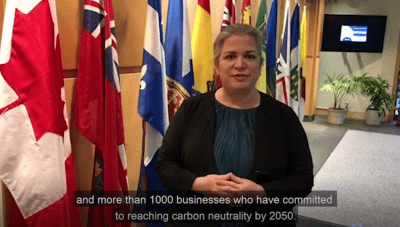 “We are proud to be collaborating with the British Embassy and our other partners on the Race to Zero Business Ambitions Forum and working for a carbon neutral world by 2050. Climate change is a global problem and it will take a coordinated response to find global solutions. Canada continues its work to reduce emissions and build resilient communities and a low carbon economy, knowing the strong connection such efforts have with long-term health and financial well-being.” – Canadian Ambassador Caroline Charette said in her closing remarks.
 “The Netherlands deems climate actions very timely and important that is why it will host the Climate Adaptation Summit on 25 January 2021, focusing on how we can adapt globally to the changing climate and what solutions need to be scaled up further. Please, join this on-line event which will mobilise governments, companies, organisations and citizens worldwide in order to set out a roadmap towards a climate-resilient future by 2030!” – Dutch Ambassador René van Hell said.


 „The extraordinary challenges, the uncertainty, have put significant pressure on leaders to make immediate, short-term decisions that help deal with the pandemic. However, it is critical that such short-term measures and the post-pandemic economic crisis do not overshadow the need to deal with issues such as climate change or sustainability, and that critical long-term decisions on which our future depends are taken as soon as possible.” – highlighted Attila Chikán Jr, president of BCSDH. „The pandemic has shown that we are able to have an impact on climate change, but also that this can only be achieved at the cost of significant sacrifice. Initiatives such as the UN’s Race to Zero program designed to foster climate neutrality, and the European Green New Deal are of vital importance. One very essential component of this activity is the transition to a circular economy. The business sector is playing a key role in these initiatives: it is thus time to take action.” – he added.
 „Circular economic goals can only be achieved with the active participation of the actors involved. In order to generate interest, we need to create conditions that help economic actors to embark on this new path to become interested in learning and applying the new approach. The Ministry of Innovation and Technology, as a founding member of the Circular Economy Platform, aims to better understand the interests of economic actors when transposing legislation setting circular economic objectives.” – highlighted Ferenc Hizó, deputy state secretary, Ministry for Innovation and Technology in his speech. „The vision of our medium-term National Waste Management Strategy, which is currently being prepared, is to make the Hungarian waste management sector one of the exemplary models of the circular economy in Europe. The measures we are planning aim to develop a waste management infrastructure that ensures the efficient use of state resources and increases the competitiveness of the waste management sector. This can benefit all actors in the sector and is expected to have a positive impact on investment in the sector.” – he added.
 The guest speaker at the Circular Economy Summit was Christian van MAAREN, founder of the exemplary Dutch Excess Materials Exchange, which supports the secondary market for wastes and surpluses. In addition to learning about a number of international and domestic examples, including corporate and start-up solutions, the Slovak Circular Platform was introduced to provide an overview of similar processes in the Visegrad countries.
 „The circular economy offers a systemic answer to the climate crisis and as such is an important solution towards limiting global warming as close as possible to 1.5°C. ING as a bank have to value differently, treat risk differently, and finance differently when it comes to the circular economy.” – said Bodor Tibor, Country Manager of ING Wholesale Banking Hungary in his speech, as one of the hosts of the conference.



 The “Subsidies provided by Coca-Cola Hungary in the first phase of the COVID-19 pandemic” program earned the award for its extremely quick response to the pandemic. During the program, significant financial and professional support was provided to the Red Cross. Business goals were subordinated to a nobler goal, while employees were also involved in volunteering tasks. In addition to helping inform society, the mobilization program also helped those in need. The award was received by Péter Kerekes, Managing Director of Coca-Cola Hungary, and László Békefi, Managing Director of Coca-Cola HBC Magyarország Kft.
 Generali’s “Life-long partnership during a pandemic” program really attracted the jury’s attention. The program is a rapid and complex response that has enabled corporate operations to become COVID-resistant, while clearly demonstrating the company’s commitment to internal and external partners. Generali offers a number of material and operational solutions that make life easier for both partners and customers. The award was received by Mihály Erdős, CEO of Generali Biztosító Zrt.
 Grundfos’ “Safety and stability in the time of a pandemic” earned the Social Responsibility Award. The complexity of their approach is clearly reflected in the program, and it is evident that the spirit of partnership is of paramount importance, with a focus on stakeholders. The health of employees is a priority, and Grundfos has also provided financial support to local hospitals. The award was received by Olivér Szundy, Managing Directorof Grundfos Magyarország Kft.