• Facebook
  • LinkedIn
  • Mail
  • Magyar Magyar Hungarian hu
  • English English English en
BCSDH
  • About us
    • Mission
      • Vision 2050
      • Management Guidelines
    • Organization
    • Partners
  • Our members
    • Membership
    • List of our members
    • Become a member
  • News
    • Our news
    • Member news
  • Our activities
    • 1. oszlop
      • Time to transform 2030
      • Race to Zero
      • Circular Economy Platform
      • ESG
      • Working groups
    • Future Leaders Program
      • Scholarship
    • For a Sustainable Future Award
    • International projects
      • ERASMUS+ DEDYCATING
      • ISSUE
      • Circular Regions
    • Archive
      • Action 2020
  • Events
    • Events calendar
    • Gallery
  • Resources
    • Business solutions
  • Circular Economy Hotspot 2026
  • Menu Menu
  • About us
    • Mission
      • Vision 2050
      • Management Guidelines
    • Organization
    • Partners
  • Our members
    • Membership
    • List of our members
    • Become a member
  • News
    • Our news
    • Member news
  • For a Sustainable Future Award
  • Our activities
    • Time to transform 2030
    • Race to Zero
    • Circular Economy Platform
    • ESG
    • Working groups
    • Future Leaders Program
      • Scholarship
    • International projects
      • ISSUE
      • Circular Regions
    • Archive
      • Action 2020
  • Resources
    • Business solutions
  • Events
    • Events calendar
    • Gallery
  • Circular Economy Hotspot 2026
You are here: Home1 / News2 / News

We have 12 years to limit climate change catastrophe, warns UN

News

Summary for Policymakers of IPCC Special Report on Global Warming of 1.5°C
approved by governments

 Limiting global warming to 1.5°C would require rapid, far-reaching and unprecedented changes in all aspects of society, the IPCC said in a new assessment. With clear benefits to people and natural ecosystems, limiting global warming to 1.5°C compared to 2°C could go hand in hand with ensuring a more sustainable and equitable society, the Intergovernmental Panel on Climate Change (IPCC) said on Monday.

The Special Report on Global Warming of 1.5°C was approved by the IPCC on Saturday in Incheon, Republic of Korea. It will be a key scientific input into the Katowice Climate Change Conference in Poland in December, when governments review the Paris Agreement to tackle climate change.

“With more than 6,000 scientific references cited and the dedicated contribution of thousands of expert and government reviewers worldwide, this important report testifies to the breadth and policy relevance of the IPCC,” said Hoesung Lee, Chair of the IPCC.

Ninety-one authors and review editors from 40 countries prepared the IPCC report in response to an invitation from the United Nations Framework Convention on Climate Change (UNFCCC) when it adopted the Paris Agreement in 2015.
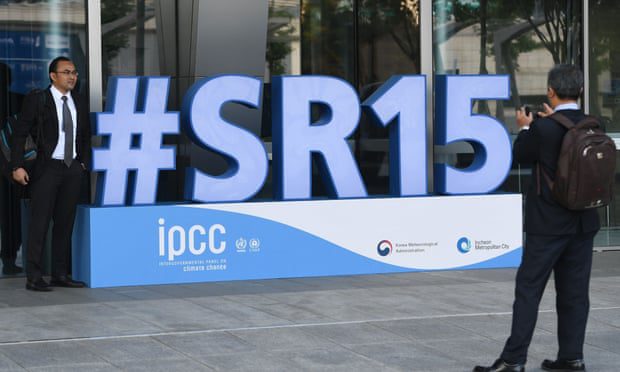
The report’s full name is Global Warming of 1.5°C, an IPCC special report on the impacts of global warming of 1.5°C above pre-industrial levels and related global greenhouse gas emission pathways, in the context of strengthening the global response to the threat of climate change, sustainable development, and efforts to eradicate poverty.

“One of the key messages that comes out very strongly from this report is that we are already seeing the consequences of 1°C of global warming through more extreme weather, rising sea levels and diminishing Arctic sea ice, among other changes,” said Panmao Zhai, Co-Chair of IPCC Working Group I.

The report highlights a number of climate change impacts that could be avoided by limiting global warming to 1.5°C compared to 2°C, or more. For instance, by 2100, global sea level rise would be 10 cm lower with global warming of 1.5°C compared with 2°C. The likelihood of an Arctic Ocean free of sea ice in summer would be once per century with global warming of 1.5°C, compared with at least once per decade with 2°C. Coral reefs would decline by 70-90 percent with global warming of 1.5°C, whereas virtually all (> 99 percent) would be lost with 2°C.

“Every extra bit of warming matters, especially since warming of 1.5°C or higher increases the risk associated with long-lasting or irreversible changes, such as the loss of some ecosystems,” said Hans-Otto Pörtner, Co-Chair of IPCC Working Group II.

Limiting global warming would also give people and ecosystems more room to adapt and remain below relevant risk thresholds, added Pörtner. The report also examines pathways available to limit warming to 1.5°C, what it would take to achieve them and what the consequences could be. “The good news is that some of the kinds of actions that would be needed to limit global warming to 1.5°C are already underway around the world, but they would need to accelerate,” said Valerie Masson-Delmotte, Co-Chair of Working Group I.

The report finds that limiting global warming to 1.5°C would require “rapid and far-reaching” transitions in land, energy, industry, buildings, transport, and cities. Global net human-caused emissions of carbon dioxide (CO2) would need to fall by about 45 percent from 2010 levels by 2030, reaching ‘net zero’ around 2050. This means that any remaining emissions would need to be balanced by removing CO2 from the air.

“Limiting warming to 1.5°C is possible within the laws of chemistry and physics but doing so would require unprecedented changes,” said Jim Skea, Co-Chair of IPCC Working Group III.
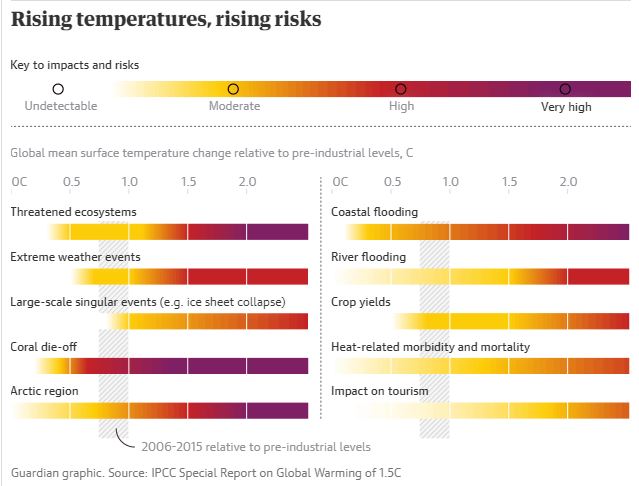
Allowing the global temperature to temporarily exceed or ‘overshoot’ 1.5°C would mean a greater reliance on techniques that remove CO2 from the air to return global temperature to below 1.5°C by 2100. The effectiveness of such techniques are unproven at large scale and some may carry significant risks for sustainable development, the report notes.

“Limiting global warming to 1.5°C compared with 2°C would reduce challenging impacts on ecosystems, human health and well-being, making it easier to achieve the United Nations Sustainable Development Goals,” said Priyardarshi Shukla, Co-Chair of IPCC Working Group III.

The decisions we make today are critical in ensuring a safe and sustainable world for everyone, both now and in the future, said Debra Roberts, Co-Chair of IPCC Working Group II.

“This report gives policymakers and practitioners the information they need to make decisions that tackle climate change while considering local context and people’s needs. The next few years are probably the most important in our history,” she said.

The IPCC is the leading world body for assessing the science related to climate change, its impacts and potential future risks, and possible response options.

The report was prepared under the scientific leadership of all three IPCC working groups. Working Group I assesses the physical science basis of climate change; Working Group II addresses impacts, adaptation and vulnerability; and Working Group III deals with the mitigation of climate change.

The Paris Agreement adopted by 195 nations at the 21st Conference of the Parties to the UNFCCC in December 2015 included the aim of strengthening the global response to the threat of climate change by “holding the increase in the global average temperature to well below 2°C above pre-industrial levels and pursuing efforts to limit the temperature increase to 1.5°C above pre-industrial levels.”

As part of the decision to adopt the Paris Agreement, the IPCC was invited to produce, in 2018, a Special Report on global warming of 1.5°C above pre-industrial levels and related global greenhouse gas emission pathways. The IPCC accepted the invitation, adding that the Special Report would look at these issues in the context of strengthening the global response to the threat of climate change, sustainable development, and efforts to eradicate poverty.

Global Warming of 1.5°C is the first in a series of Special Reports to be produced in the IPCC’s Sixth Assessment Cycle. Next year the IPCC will release the Special Report on the Ocean and Cryosphere in a Changing Climate, and Climate Change and Land, which looks at how climate change affects land use.

The Summary for Policymakers (SPM) presents the key findings of the Special Report, based on the assessment of the available scientific, technical and socio-economic literature relevant to global warming of 1.5°C.

The Summary for Policymakers of the Special Report on Global Warming of 1.5°C (SR15) is available at https://www.ipcc.ch/report/sr15 or www.ipcc.ch.

Source: IPCC, Photos: The Guardian,

Diana Ürge-Vorsatz, @IPCC WGIII Vice-Chair, presented the emission pathways and system transitions, consistent with 1.5°C global warming #SR15 during the scientific workshop in Hanoi.
Emission Pathways and System Transitions Consistent with 1.5°C Global Warming from ipcc-media
11.10.2018
0 0 eszter.chikankovacs https://bcsdh.hu/wp-content/uploads/2021/12/bcsdh-logo.png eszter.chikankovacs2018-10-11 21:14:162018-10-11 21:14:16We have 12 years to limit climate change catastrophe, warns UN

Companies can play an important role in promoting the uptake of sustainable lifestyles

News

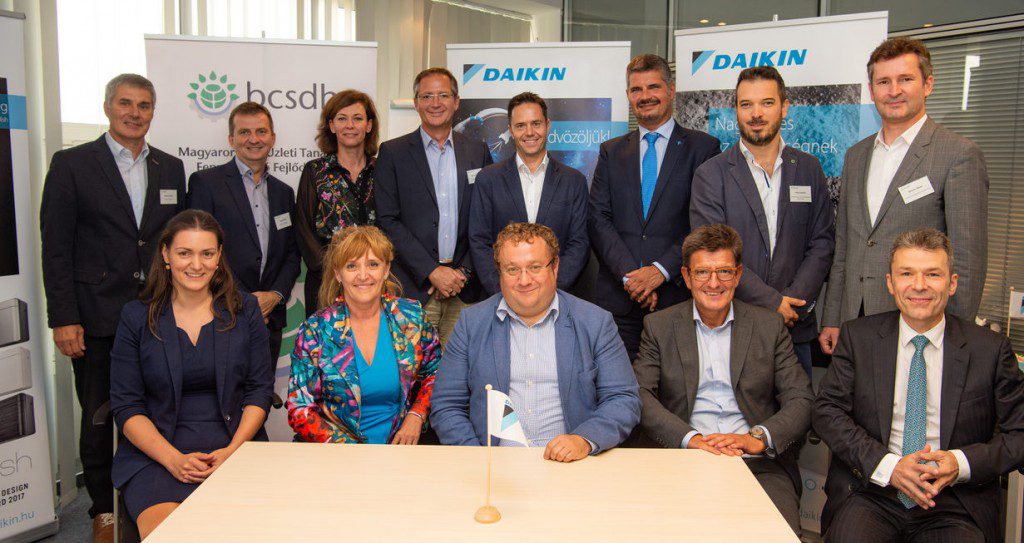
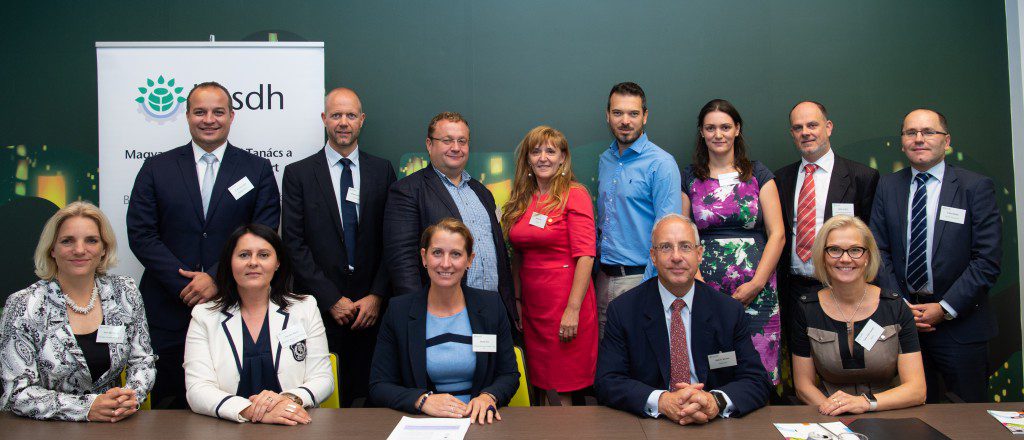
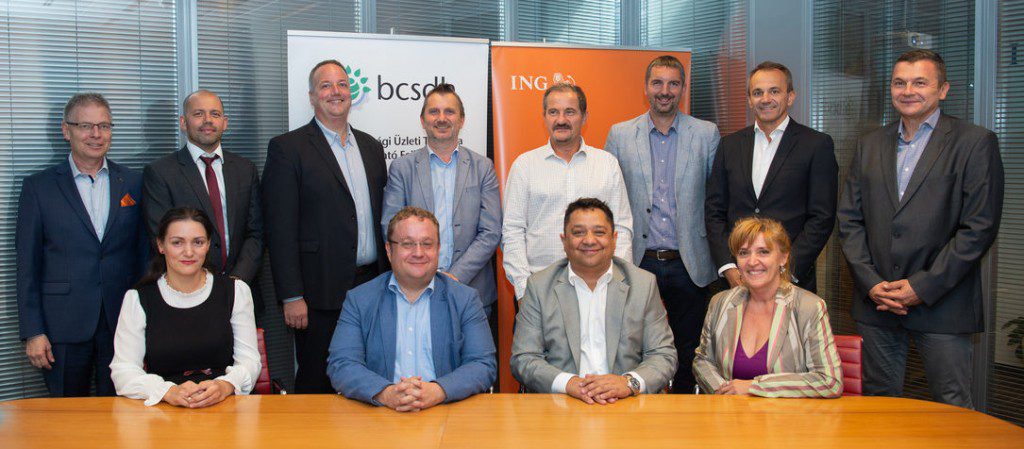
By shaping the demand and supply of sustainable products and services, companies can do a lot to promote sustainable lifestyles more widely  – emphasized participants at the CEO round table discussions in June and in early September that focused on Sustainable Lifestyles through the Action 2020 Hungary program.

BCSDH’s CEO round-table discussions were held in June and continued in September. The purpose of the events was to define those focal areas in which BCSDH can define concrete recommendations and activities for the business sector. The hosts of the round-table discussions were BCSDH’s member companies Legrand Zrt., Daikin, Heineken, and ING.

Participants agreed that all companies, regardless of industry and size, have great potential in this area. The introduction of new business models, most of all the circular economy, can not only reduce ecological stress but also costs, thereby contributing to making sustainable lifestyles more affordable. Growing demand for sustainable products and services can be perceived in many sectors, but consumer education is still a big challenge for companies and brands.

The aim of BCSDH is to define recommendations and activities for the business sector regarding sustainable lifestyles with which companies can create real impact. Moreover, companies can introduce their business solutions on 18th October at  our business lunch and in related publications so that they can be adapted by other companies.

The main sponsors of the  Action2020 program in 2018 are Mastergood and Nestlé;  highlighted sponsors are Alteo, McDonald’s, MOL and Unilever; further sponsors include Allianz, E.On, Essity, Folprint, Hungarocontrol, HVG, KPMG and Rossmann.


Photos taken at these events can be found on a gallery at our website.

21.09.2018
0 0 eszter.chikankovacs https://bcsdh.hu/wp-content/uploads/2021/12/bcsdh-logo.png eszter.chikankovacs2018-09-21 11:04:562018-09-21 11:04:56Companies can play an important role in promoting the uptake of sustainable lifestyles

BUDAPEST ENERGY SUMMIT – 3-6th December 2018

News

Budapest Energy Summit will be organized on the 3-6th of December 2018 at Budapest, Hungary. 

BEST2018 includes the CLEAN ENERY Forum, the INNOVATION Hub and also the first WOMEN in ENERGY Conference.


Date: 3-4-5-6 December, 2018 (Monday-Thursday)

Venue: Hotel Marriott Budapest


Some confirmed speakers of the summit:

Maros Sefcovic, Vice President, European Commission

Péter Szijjártó, Minister of Foreign Affairs and Trade

László Palkovics, Minister of Innovation and Technology

Dr. Karsten Wildberger, Member of the Board, COO, E.ON

Lászlo Varró, Chief Economist, IEA

Elena Burmistrova, CEO, Gazprom Export

Anita Orbán, Vice President, Tellurian

Léon Wijnands, Global Head of Sustainability, ING Bank

Gergely Szabó, Country Chariman Hungary, MET Group

Andrew Walker, Vice President Strategy, Cheniere

Mohamed Anis, Tech Evangelist, INFOSYS


Book your EARLY BIRD ticket with 20% discount on our website

www.budapestenergysummit.hu

Would you have any question we are happy to answer them – please contact us:

bernadett.forizs@whitepaperconsulting.hu


Platina Sponsor:

11.09.2018
0 0 Takacs Ivett https://bcsdh.hu/wp-content/uploads/2021/12/bcsdh-logo.png Takacs Ivett2018-09-11 09:33:312018-09-11 09:33:31BUDAPEST ENERGY SUMMIT – 3-6th December 2018

Irén Márta, Managing Director of BCSDH, has been awarded a Pro Facultate Prize

News

Irén Márta, Managing Director of the Business Council for Sustainable Development in Hungary (BCSDH) received this year’s PRO FACULTATE Prize from Corvinus University’s Faculty of Business Administration during the faculty graduation ceremony on 25 July, 2018.

Dr.  Zoltayné  Dr.   Paprika  Zita,  Dean  of  the  Faculty  of  Business  Administration ,Dr. László Gulácsi, Scientific Vice-rector, and Dr. Richárd Szántó, Deputy Dean of Education, awarded this prize to Irén Márta, Managing Director of the BCSDH, in recognition of her achievements in the business sector, and moreover for her activities regarding the practical and scientific development of this area in cooperation with the Faculty of Business administration.

***


The  prestigious  Pro Facultate  Award  of  the  Faculty  of  Business  Administration  was  established  in  2010  to  recognise  prominent  people  who have enhanced  the  reputation  and  authority  of  the  Faculty  regarding  the  collaboration  of  the  business  sector  and  the  scientific  world.

The  prize  is  awarded  once  a  year  following the  proposal of  the  Dean’s  Cabinet  of  the  Faculty  of  Business  AAdministration by the  faculty  Council.  The  prize  winner  may  be  nominated  by  the  heads  of departments.

25.07.2018
0 0 eszter.chikankovacs https://bcsdh.hu/wp-content/uploads/2021/12/bcsdh-logo.png eszter.chikankovacs2018-07-25 13:00:202018-07-25 13:00:20Irén Márta, Managing Director of BCSDH, has been awarded a Pro Facultate Prize

The Voluntary National Review of Hungary on the Sustainable Development Goals has been conducted with the assistance of BCSDH

News

The Ministry of Foreign Affairs and Trade invited the Business Council for Sustainable Development in Hungary (BCSDH) to assist as a professional partner in conducting the business chapter of the Voluntary National Review.

The Business Council has conducted a survey among it’s member companies, and in addition, it has involved 8 partner organization to ensure the professional background of the review, which was finalised at a reconciliation forum.

The Hungarian review is available at the website of the UN:

https://sustainabledevelopment.un.org/index.php?page=view&type=30022&nr=622&menu=3170

The involved partner organizations of BCSDH:

British Chamber of Commerce in Hungary, Confederation of Hungarian Employers and Industrialists, French-Hungarian Chamber of Commerce and Industry, Hungarian Donors Forum, Joint Venture Association, KÖVET Association for Sustainable Economies, Netherlands-Hungarian Chamber of Commerce in Budapest, Swisscham Hungary

To read the report click here.

17.07.2018
0 0 Takacs Ivett https://bcsdh.hu/wp-content/uploads/2021/12/bcsdh-logo.png Takacs Ivett2018-07-17 11:26:172018-07-17 11:26:17The Voluntary National Review of Hungary on the Sustainable Development Goals has been conducted with the assistance of BCSDH

Hybrid corn, and consecrated mineral well water – report from the BCSDH Weekend

News

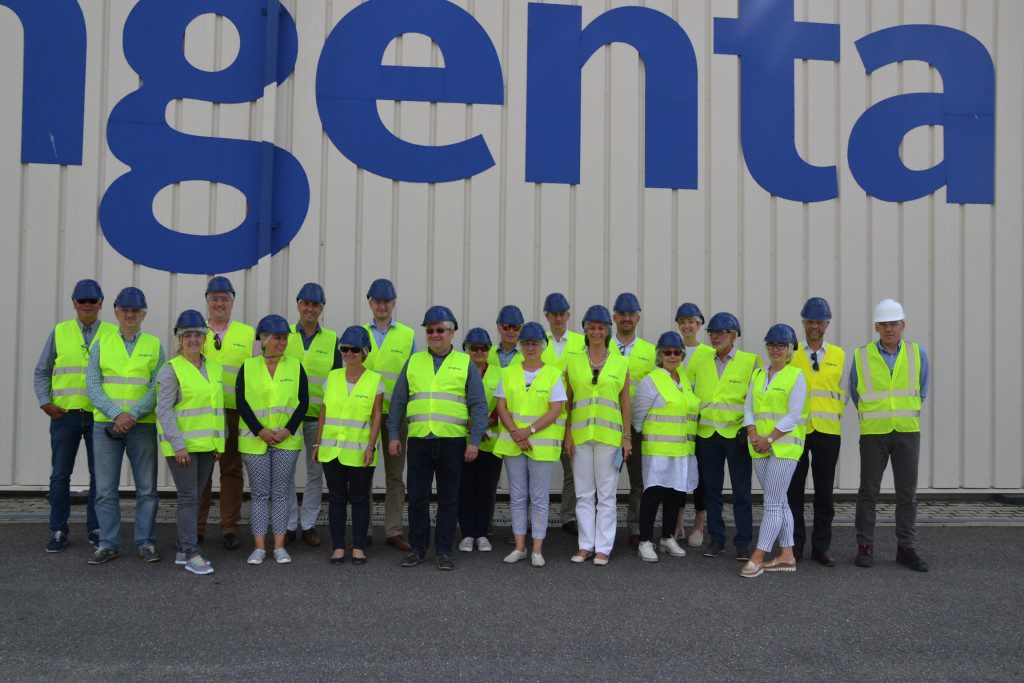
This year’s BCSDH Weekend was a delightful program for the 15 participating CEOs and their partners.

One of the hosts of the event was Matthew Pickard, CEO of Syngenta. The company’s factory in Mezőtúr processes and packages drought-tolerant hybrid seeds produced in the area, which also result in a fourfold yield. The visit also gave us an opportunity to present the Contívo project, in which farmers are taught about sustainable and efficient farming. The advantages and process of  sustainable growing were described at Syngenta’s farm in Dióskál.

Syngenta’s outstanding example of waste management was also explained. Each and every part of the corn is used, and the waste that is generated enters the circular economy as it can be used as raw material in other industries. Seeds will be sown, while the husks and cobs will be used for animal feed or as a raw material in cosmetics.

In the evening, a Frittmann wine tasting – a local phenomenon – was held at Hercegasszony Birtok, which was followed by a dinner made from local ingredients. An emerging small start-up company, TL Jeans, “dressed up” wines that were given to participants as a gift

On Saturday morning, guests were invited into the bottling plant of Szentkirályi-Kékkúti Mineral Water Kft. by the managing director, Olivér Martin. In Szentkirály, the mineral water comes to the surface in the middle of a beautiful park inside a sanctified chapel,before obtaining its final form on a most modern bottling line.

Besides listening to the success story of Szentkirályi, sustainability issues were also discussed. The company mentioned that the European Association of Mineral Water Suppliers – which it is a member of – defined the goal of collecting 90% of their PET bottles by 2025. In Hungary, the collection rate is still low, despite the fact that the infrastructure is adequate. It is highly important to raise awareness about this issue.

The two-day trip closed with an enjoyable lunch in Kecskemét.

We hereby thank the host companies and their leaders for their substantial professional program and generous hospitality.

Pictures of the event can be found here.

12.06.2018
0 0 eszter.chikankovacs https://bcsdh.hu/wp-content/uploads/2021/12/bcsdh-logo.png eszter.chikankovacs2018-06-12 14:01:022018-06-12 14:01:02Hybrid corn, and consecrated mineral well water – report from the BCSDH Weekend

Sustainability reporting GRI Certified 16-hour Training in Budapest- 13-14 September

News

The two-day “The GRI Standards” training is for organisation/individuals who either start reporting in line with GRI now, or have been using the previous guidelines but wish to have a comprehensive introduction to the new set of standards.

The course will give a detailed introduction to the new generation of GRI Standards and to Sustainability Reporting. Each training course is tailored to a local country/region, we use specific case studies and exercises to develop practical knowledge and competencies based on almost 20 years of reporting experience.

Sustainability reporting helps organizations to become more responsible, accountable and contribute effectively to sustainable development; to engage with stakeholders and build corporate reputation. But to prepare and publish a report needs more than data, wording and editing.

The course helps reporters understand the value of reporting and, crucially, how to use the GRI Standards for their sustainability reporting processes.

The training provides a general overview on the reporting process and areas:
• starting with definitions, global and local trends (also regulation, e.g. EU mandatory reporting)
• the reporting process (what is reporting, how to measure sustainability, GRI principles and indicators), also
• concrete reporting dilemmas (printed or online, which target group, how to communicate it effectively, how to prioritize issues, how to engage internally and externally, etc.).

Date: 13-14 th September 2018

Discount: – 10% discount for those companies which are members of BCSDH

More information about the training you can find here.

You can download the registration form from here.

More information and contact:
Mandy Fertetics: fertetics.mandy@alternate.hu +36-20-947-1884
Katalin Urbán: urban.katalin@alternate.hu; +36-20-932-9160

20.05.2018
0 0 eszter.chikankovacs https://bcsdh.hu/wp-content/uploads/2021/12/bcsdh-logo.png eszter.chikankovacs2018-05-20 16:12:212018-05-20 16:12:21Sustainability reporting GRI Certified 16-hour Training in Budapest- 13-14 September

THE ENERGY SECTOR IS NOT FOR GUYS ONLY! CALL FOR APPLICATIONS DEADLINE: 2 June, 2018

News

Women in Energy Association’s call for application to the next semester of their mentoring program

Be part of shaping the future!

Start your carrier in the energy sector!

Join WONY’s mentoring program and we will help you get acquainted with this exciting sector and assist you to improve your job opportunities.

Are you of the view that the energy sector is for guys only? Are you afraid that only men can get a meaningful job in this sector? Do you think this sector only offers opportunities if you have a degree in engineering? We do not think so. Women in Energy Association (www.womeninenergy.eu) is here to bust these myths.

Our Association aims to increase the publicity and visibility of all the exciting, but not really well known jobs that this priority sector of the economy might offer to the young generation of female specialists. Our members have joined forces to support each other and the young generation of female university leavers in order to improve the number of female employees and their carrier opportunities in the energy sector.

If you are studying engineering, law or economics and you have completed at least 3 semesters, apply for the autumn 2018 / spring 2019 semester mentoring programme by Women in Energy Association. Mentors with extensive and diverse experience in the energy sector will help you to

  1. learn about your carrier opportunities
  2. have a taste of what it feels like to work in this sector through your personal mentor,
  3. take part in networking events
  4. develop your skills and competencies essential at the job market and carrier development
  5. benefit from personal consultation by our members active in various segments of the energy sector.

We do count on applicants to be able to take part in all the activities the programme offer, but occasionally we can also provide online consultation. Please only apply if you can dedicate at least 40 hours in the two semesters to participate in the programme activities.

Please send your English language application on the form available on our website www.womeninenergy.eu to Ms Bernadett Fórizs at Bernadett.forizs@whitepaperconsulting.hu by 2 June 2018. We will notify applicants if they have been accepted by 30 June 2018.

Andrea PÁNCZÉL
Chair
Women in Energy Association

07.05.2018
0 0 eszter.chikankovacs https://bcsdh.hu/wp-content/uploads/2021/12/bcsdh-logo.png eszter.chikankovacs2018-05-07 14:25:262018-05-07 14:25:26THE ENERGY SECTOR IS NOT FOR GUYS ONLY! CALL FOR APPLICATIONS DEADLINE: 2 June, 2018

BCSDH urges regional and corporate cooperation

News

“The circular economy is the business model of the future” – said Jacqueline Cramer on April 25, 2018 at the BCSDH Business breakfast and Action 2020 Forum, which was focused on promoting sustainable lifestyles and, more specifically, the circular economy.


 Professor Jacqueline Cramer, circular economy ambassador of the district of Amsterdam and former Dutch Environment Minister, gave a great performance at the Business Council for Sustainable Development in Hungary’s (BCSDH) Business Breakfast and Action 2020 Forum. The organization’s Business Breakfast – which involves a forum of 81 member companies that produce 30% of Hungary’s GDP – was followed by workshops with business leaders and experts that will help the business sector to take meaningful steps regarding the promotion of sustainable lifestyles.

 “The full implementation of the circular economy requires the appropriate scale. In this, regional or corporate communities are crucial. The inevitable first step is sharing knowledge and experiences and undertaking joint action which can accelerate the emergence of sustainable supply chains and thereby drive the expansion of the circular economy. By becoming part of such a community, we can take shared steps that we would never be able to manage on our own.” – explained Jacqueline Cramer.

According to some estimates, the circular economy has business potential of 4500 billion USD by 2030 globally.


“Transitioning to a circular economy is one of the greatest business opportunities nowadays. The core of the concept is not yet deeply acknowledged by most companies, although use of this model can increase the flexibility of the economy and facilitate the achievement of the Paris Agreement on Climate Change and the United Nations Sustainable Development Goals. BCSDH is a corporate community that can help companies share knowledge and experiences, as well as contribute to working as a team in this area”- said Attila Chikán, President of the BCSDH in his introduction.


Hungary’s ecological footprint is 3.6 gha per person, although available bio-capacity is only 2.68 global hektar (gha) per capita
– as with many other countries in the world, there is considerable over-consumption in Hungary too. A sustainable economy can only be based on sustainable consumption. The main objective of the Action 2020 Hungary program is to ensure sustainable consumption by fostering adequate levels of supply and demand that will result in a better quality of life, while taking ecological limits into account.

“The circular economy is just one of the areas that plays a major role in achieving the goals of the Action 2020 Sustainable Lifestyle, and probably it is also the biggest challenge today in Hungary. The other two priority areas are sustainable products and services, as well as consumer decisions. During the Forum we have tried to explore and identify existing business solutions that provide immediate-, short- and medium-term results”- said Valentin Póka, Country Manager of Coface, BCSDH’s Action 2020 Sustainable Lifestyle Working Group Leader.

The primary purpose of the Action2020 Forum was to launch and support effective teamwork and joined-up thinking in the business sector while creating a real impact. Fifty-seven companies have already joined the program.

The main sponsors of the Action 2020 Hungary program include Mastergood and Nestlé, while the highlighted sponsors are Alteo, McDonald’s, MOL and Unilever. Other sponsors include E.On, Essity, Folprint, HVG, KPMG and Rossmann.

25.04.2018
0 0 eszter.chikankovacs https://bcsdh.hu/wp-content/uploads/2021/12/bcsdh-logo.png eszter.chikankovacs2018-04-25 15:52:362018-04-25 15:52:36BCSDH urges regional and corporate cooperation

Member companies of BCSDH are committed to the Sustainability Development Goals (SDGs)

News

The Sustainable Development Goals have become a focus of the annual general assembly of the Business Council for Sustainable Development Hungary (BCSDH), which this year was hosted at MAVIR’s headquarters. Based on BCSDH’s survey, 70% of the companies we consulted have already committed to one or more of the SDGs.

BCSDH’s member list comprises 80 CEOs whose companies produce 30% of Hungarian GDP and thus represent a value-creating community. At its annual general assembly held on 27 February 2018, the organisation revealed preliminary results from its SDG-related survey. It transpires that 70% of respondent companies claim that they are contributing to meeting the SDGs, and that another 15% are also preparing to take action.

Through use of the survey, BCSDH was interested in revealing whether companies are contributing to the fulfilment of the UN Sustainable Development Goals which were adopted in September 2015, and how many concrete objectives have been defined in relation to these goals. Evaluation of the survey is still in progress and final results will be published in May.

László Módos, Deputy CEO of MAVIR, welcomed the members of the BCSDH member companies.

“During the 2017 jubilee year, BCSDH became the voice of the business world in sustainability-related issues. The process of policy reconciliation has already begun, and will continue in 2018. The business sector and the BCSDH are also taking action to achieve the United Nations’ and Hungary’s Sustainable Development Goals “- said Attila Chikán Jr., president of the organization.

“One of the important milestones of the jubilee year was the establishment of the For a Sustainable Future Prize, which recognises outstanding corporate and individual achievements in sustainability and SDG-related topics” said Irén Márta, managing director of BCSDH.

CEOs that have already defined goals to support the achievement of the SDGs include Tibor Bodor (ING), Kornél Szepessy (HungaroControl), László Károlyi (Legrand), and László Módos (MAVIR). The company leaders took part in a roundtable discussion where they provided insight into their companies’ practical efforts to help meet the SDGs, assisting those who are still at the beginning of this process.

The SDG Compass (which was compiled by the GRI, the UN Global Compact and the WBCSD) was presented at this event. This instrument helps companies achieve their SDG-relevant goals, fulfil their strategic integration targets, and also contribute to the more accurate measurement of goals that are achieved.

The BCSDH also welcomed five new member companies (ABB, MET, Microsoft, PWC, and UTC Overseas) on the annual assembly attended by nearly 70 senior executives and delegates.

Click here to see pictures from the event.


27.02.2018
0 0 eszter.chikankovacs https://bcsdh.hu/wp-content/uploads/2021/12/bcsdh-logo.png eszter.chikankovacs2018-02-27 21:27:302018-02-27 21:27:30Member companies of BCSDH are committed to the Sustainability Development Goals (SDGs)
Page 21 of 35«‹1920212223›»
Followon TwitterSubscribeto RSS Feed

Latest news

Categories

  • Award
  • Business Solution Award
  • Business Transformation award
  • Change Leader Award
  • Kiemelt hírek
  • Leading women award
  • Member News
  • New member
  • News
  • új tagvállalat
  • Uncategorized

Archives

  • March 2026
  • February 2026
  • January 2026
  • December 2025
  • November 2025
  • October 2025
  • September 2025
  • August 2025
  • July 2025
  • June 2025
  • May 2025
  • April 2025
  • March 2025
  • February 2025
  • January 2025
  • December 2024
  • November 2024
  • October 2024
  • September 2024
  • August 2024
  • July 2024
  • June 2024
  • May 2024
  • April 2024
  • March 2024
  • February 2024
  • January 2024
  • December 2023
  • November 2023
  • October 2023
  • September 2023
  • August 2023
  • July 2023
  • June 2023
  • May 2023
  • April 2023
  • March 2023
  • February 2023
  • January 2023
  • December 2022
  • November 2022
  • October 2022
  • September 2022
  • August 2022
  • July 2022
  • June 2022
  • May 2022
  • April 2022
  • March 2022
  • February 2022
  • January 2022
  • December 2021
  • November 2021
  • October 2021
  • September 2021
  • August 2021
  • July 2021
  • June 2021
  • May 2021
  • April 2021
  • March 2021
  • February 2021
  • January 2021
  • December 2020
  • November 2020
  • October 2020
  • September 2020
  • July 2020
  • June 2020
  • May 2020
  • April 2020
  • March 2020
  • February 2020
  • January 2020
  • December 2019
  • November 2019
  • October 2019
  • September 2019
  • August 2019
  • July 2019
  • June 2019
  • May 2019
  • April 2019
  • March 2019
  • February 2019
  • January 2019
  • December 2018
  • November 2018
  • October 2018
  • September 2018
  • August 2018
  • July 2018
  • June 2018
  • May 2018
  • April 2018
  • February 2018
  • January 2018
  • December 2017
  • November 2017
  • October 2017
  • September 2017
  • May 2017
  • April 2017
  • March 2017
  • February 2017
  • December 2016
  • November 2016
  • October 2016
  • September 2016
  • August 2016
  • July 2016
  • June 2016
  • May 2016
  • April 2016
  • March 2016
  • February 2016
  • December 2015
  • November 2015
  • October 2015
  • September 2015
  • August 2015
  • July 2015
  • June 2015
  • April 2015
  • March 2015
  • February 2015
  • January 2015
  • December 2014
  • November 2014
  • October 2014
  • September 2014
  • August 2014
  • July 2014
  • June 2014
  • May 2014
  • April 2014
  • March 2014
  • February 2014
  • January 2014
  • December 2013
  • November 2013
  • September 2013
  • July 2013
  • June 2013
  • May 2013
  • April 2013
  • March 2013
  • February 2013
  • January 2013
  • November 2012

Business Council for Sustainable Development in Hungary
1118 Budapest, Ménesi street 9/a.

About us
Our mission
Our vision
Our Members
Annual Report
Contact

Carbon-aware events
Gallery

Policies and statements
Privacy policy
Competition Law Statement
Code of Ethics

World Business Council for Sustainable Development (WBCSD) National Partner

© Copyright - BCSDH - powered by Enfold WordPress Theme
  • Facebook
  • LinkedIn
  • Mail
Scroll to top