• Facebook
  • LinkedIn
  • Mail
  • Magyar Magyar Hungarian hu
  • English English English en
BCSDH
  • About us
    • Mission
      • Vision 2050
      • Management Guidelines
    • Organization
    • Partners
  • Our members
    • Membership
    • List of our members
    • Become a member
  • News
    • Our news
    • Member news
  • Our activities
    • 1. oszlop
      • Time to transform 2030
      • Race to Zero
      • Circular Economy Platform
      • ESG
      • Working groups
    • Future Leaders Program
      • Scholarship
    • For a Sustainable Future Award
    • International projects
      • ERASMUS+ DEDYCATING
      • ISSUE
      • Circular Regions
    • Archive
      • Action 2020
  • Events
    • Events calendar
    • Gallery
  • Resources
    • Business solutions
  • Circular Economy Hotspot 2026
  • Menu Menu
  • About us
    • Mission
      • Vision 2050
      • Management Guidelines
    • Organization
    • Partners
  • Our members
    • Membership
    • List of our members
    • Become a member
  • News
    • Our news
    • Member news
  • For a Sustainable Future Award
  • Our activities
    • Time to transform 2030
    • Race to Zero
    • Circular Economy Platform
    • ESG
    • Working groups
    • Future Leaders Program
      • Scholarship
    • International projects
      • ISSUE
      • Circular Regions
    • Archive
      • Action 2020
  • Resources
    • Business solutions
  • Events
    • Events calendar
    • Gallery
  • Circular Economy Hotspot 2026
You are here: Home1 / News2 / News

Is the circular economy the Swiss army knife of ESG reporting? – Report about the sixth Circular Economy Summit

News

As a complex system, the circular economy is associated with efficient tools for addressing climate change, biodiversity, and ESG issues. This key message was at the forefront of the sixth Circular Economy Summit, which took place on November 23, 2023, attracting close to 180 participants and significant interest. During the event, the ‘The Tulip Award for Sustainability’ was presented.

‘Each year, we use 1.75 times as many resources as Earth can replace to sustain our lifestyles, and the supply of ecosystem goods and services cannot keep up with our needs. Damaged ecosystems exacerbate climate change, undermine food security, and put people and communities at risk. While real social needs could be met with 30% less material consumption, our economy is still continuously using more material. In this situation, accelerating the transition to a circular economy is in our common interest, as the associated reduction in consumption alone would represent a solution to numerous climate and ecological crises. Immediate action is also needed in this area.’ – said Attila Chikán Jr., President of BCSDH, in his speech.


The index of global material use is deteriorating. While in 2018, 9.1% of all raw materials used in the world economy came from recycled materials, this number had dropped to 7.2% by 2023. And as business as usual continues, the amount of material used globally may increase by up to 84% by 2050, while global social needs could be met with 70% of the material that is currently used. Reducing consumption to this extent would significantly positively impact several ecological tipping points

Today, the Circular Economy Platform, established at the initiative of the Hungarian Business Council for Sustainable Development (BCSDH), the Dutch Embassy, and the Hungarian Ministry of Innovation and Technology, consists of 99 members. These institutions have highlighted knowledge-sharing, collaboration, and immediate action as the platform’s most important tasks.

According to the BCSDH’s second survey on the state of the circular economy in Hungary, 73% of domestic companies see the transformation of production processes as crucial, while 66% focus on extracting resources from waste, and 62% are prioritizing waste management for the future. Consumer behaviour change will not be the primary driver of these changes, but a significant proportion of current initiatives target consumers and could play a crucial role in fostering awareness. However, systemic changes are still lacking.

Dr. Anikó Raisz, State Secretary for Environment and Circular Economy at the Ministry of Energy, spoke about the current regulatory environment for the circular economy in Hungary.

In Hungary, phasing out single-use plastics, implementing an extended producer responsibility system, introducing a new mandatory deposit system, and the newly operational concession-based waste collection system are seen as the sole opportunities to meet EU and Hungarian climate goals. These initiatives could also mark significant progress toward adopting a circular economy. Our goals are ambitious, and the OECD study released this spring, in which BCSDH played a significant role, provides guidance for achieving them.

According to the BCSDH survey, 69% of companies expect assistance transitioning to a circular economy involving government incentives, while 59% look to regulatory measures for support. There is great anticipation regarding these ongoing changes.

Among our internationally recognized speakers was Vincent GRUIS, Prof. Dr.ir., Professor of Housing Management at Delft University of Technology, who discussed the transition path towards more circular and sustainable construction—an essential area. Joost van Dun, the Circular Economy Lead at ING Bank, showcased through examples how circular economy criteria can be applied in sustainable finance during his presentation.

Camilla Visconti, Consultant at Circle Economy Consulting, highlighted during her presentation on the CSRD toolkit that it is the first reporting system in which reporting on progress in the circular economy is mandatory.

The role of SMEs (Small and Medium-sized Enterprises) in the transition to a circular economy is crucial, and they may be supported on their path towards sustainability by the OPTEN ESG Index. Dr. Hajnalka Csorbai, Strategic Director of OPTEN Informatikai Kft., introduced this index during the event.

A panel discussion focused on the relationship between the circular economy and ESG. Participants, including Tibor Bodor, CEO of ING Bank; Kam Jandu, CEO of Budapest Airport; Károly Gábor Nyári, Vice President and Head of FP&A at Grundfos; and Richárd Végh, CEO of the Budapest Stock Exchange, explored the significance of ESG compliance across various sectors and how fulfilling ESG criteria can be supported by the principles of the circular economy. The roundtable was moderated by Irén Márta, Managing Director of BCSDH.

Transitioning towards a circular economy and sustainable operations involves the crucial integration of ESG (Environmental, Social, and Governance) factors into the investment process. This framework ensures transparent, sustainable business practices that are measurable and reportable. Both the circular economy and ESG are pivotal for mitigating investment risks, meeting commitments to climate protection and biodiversity, and leveraging new forms of sustainable growth.

Az event’s second panel discussion focused on reforming Hungary’s waste management system, moderated by Bálint Bartha-Horváth PHD, Senior Sustainability Consultant at CBRE. Participants included Martin Basila, Founder and CEO of Sensoneo; Dr. Viktória Bodnár PHD, Managing Director of IFUA-Horváth & Partners Ltd.; and Tivadar Runtág, Material Flow Director at MOHU MOL Waste Management Ltd.

The new comprehensive waste management system has launched with the aim of achieving 90% functionality within three years. There are many unforeseen challenges ahead. Several smaller, older players did not register in the system, and the extent of illegal waste imports exceeds initial estimates. The stakes are high as significant volumes of valuable materials are ending up in the trash. The mandatory deposit return system starts with the installation of approximately 2000 return machines nationwide, which could increase to 4000-6000. Educating stakeholders is crucial, thus a significant and multi-layered campaign is launching to ensure that consumers across various age groups and market players understand every detail of the new system.

The Hungarian Green Building Council (HuGBC) has made an unprecedented and meaningful zero-carbon recommendation specifically for buildings in our country. This recommendation urges action from stakeholders within the construction industry to achieve the crucial 2050 climate goal. Gábor Szarvas, President of the HuGBC, presented this recommendation.


‘The Tulip Award for Sustainability’

For the first time, the Circular Economy Summit hosted the presentation of the “Tulip Award for Sustainability,” established by the Embassy of the Kingdom of the Netherlands in Hungary.

The aim of the award is to annually recognize SMEs, startups, companies, or nonprofit organizations that demonstrate outstanding performance in sustainability within a particular industry. This year’s award theme was the ‘Sustainable and Circular Construction Industry.’

“The circular economy remains an important priority for the Netherlands as the country wants to be fully circular by 2050. To achieve this ambitious goal, we should also build more sustainably as the construction sector accounts for half of the raw material consumption in the Netherlands,” – emphasized Désirée Bonis, Dutch ambassador to Hungary, in her speech.

This year, the prize was won by a young architectural company, Equinox International, for its holistic approach to the sustainability of its residential buildings. A special prize was given to Café Plusz Kft. for promoting hempcrete as a sustainable construction material.

A six-member professional jury evaluated the applications that were submitted, comprising:

Dr. Barbara Botos, Travelling Ambassador for Climate Affairs and Climate Diplomacy, Ministry of Energy

Zsombor Barta, Ambassador of the Hungarian Green Building Council (HuGBC)

Andrea Istenesné Solti, President of the Hungarian Business Leaders Forum (HBLF), Shell Hungary Zrt. Chair

Zoltán Krázli, Program Director of GS1 Hungary Nonprofit Ltd., Coordinator of the Lean & Green Platform

Irén Márta, Managing Director of the Business Council for Sustainable Development Hungary (BCSDH)

Katinka Zinnemers, President of the Dutch-Hungarian Chamber of Commerce (Dutcham), Managing Director of Abacus Medicine A/S

BCSDH – one of the founders of the Circular Economy Platform – strives to be a community of highly committed companies and business leaders and is encouraging and supporting its more than 140 member companies – and, following them, the business sector as a whole – to go ‘beyond emissions’ and focus on biodiversity conservation and restoration and reverse growing social inequality.

This is what our Time to Transform 2030 (a decade-defining program built on the achievements of Action 2020) is all about, to which our Circular Economy Platform is also connected.


Thanks to the main sponsor of the Summit:

Thanks to our sponsors of the Circular Economy Platform 2023:

****


What is a circular economy?

In the current linear economic model, technical and biological components are extracted from nature, transformed, and, after use, treated as waste, much of which is not recycled.

In the circular economy model, on the other hand, metabolic processes occur in a closed loop, waste is almost 100% recycled, and biological and technological components are returned to circular processes without any loss of quality.

Therefore, the shift to a circular economy involves rethinking the relationship between markets, consumers, and natural resources through the responsible management of natural resources.

23.11.2023
https://bcsdh.hu/wp-content/uploads/2023/11/DSC_6774-e1700753231808.jpg 650 1099 eszter.chikankovacs https://bcsdh.hu/wp-content/uploads/2021/12/bcsdh-logo.png eszter.chikankovacs2023-11-23 16:21:592023-11-28 15:31:14Is the circular economy the Swiss army knife of ESG reporting? – Report about the sixth Circular Economy Summit

Can bee pastures be part of business strategy?

News

On 16 November, at our last Race to Zero Working Group this year, we got a better insight into the operations and long-term commitment of two of our member companies, and a definitive “yes” to the question in the title.

With the help of our host, János Kocsány, CEO of Graphisoft Park, we were able to learn about the history of the brownfield project, which is unprecedented in Europe. We chose this as one of the topics of the meeting because this year Graphisoft Park won the Sustainable Future Award in ‘Business Solution – Biodiversity‘ category for its forward-thinking solutions. Moreover, the park, with 60% green space, has an outstanding tenant loyalty index (15 years) and is not just building offices, but a cohesive community, with a special focus on nature conservation and restoration.

Graphisoft Park’s case study with results and inspiring thoughts so far is also available in the Business Solutions sub-page under Resources on BCSDH’s website, along with several other examples of companies promoting biodiversity and climate adaptation.

The presentation by András Zakar, Director General of FŐKERT Division for Urban Park Management of Budapest Public Utilities Nonprofit Plc. showed that the Főkert is responsible for the maintenance and protection of 6 million m2 of green space in 479 locations. In addition to the more familiar bee pastures, he talked about the Stockholm tree planting method, low-impact plant protection and the Miyawaki mini-forests, of which there are already six in Budapest. They have their own plant nursery and a strong focus on monitoring and testing, and then applying best practices based on the results. Sustainable operations are supported by a fleet of electric vehicles, and waste management is also a priority. The main tasks of Főkert are public, but they are also keen to help companies to protect natural diversity, either by working with them to develop or rehabilitate a new area, or by involving employees in voluntary activities. Education and awareness-raising are a priority in all activities, as they know that the only way to protect nature is to involve people.

Andrea Nagy, BCSDH’s project manager, briefly presented this year’s Race to Zero programme and the professional materials, films and presentations related to the 2023 biodiversity flagship theme, which can provide a good summary and inspiration for further strategic thinking. This was followed by the 2024 targets, where there will be a continued focus on showcasing good business practices and collecting business solutions. In addition to the traditional workshops, we will also visit external sites.

Finally, Dorka Veress, HR and PR Manager of Graphisoft Park, gave an unusual behind-the-scenes tour of the site, where we could see how an old forge is transformed into a high-tech office space, what an unused area looks like, and we also had the chance to see the Generator House. In the close-to-nature office park you can find a bee pasture, a wetland with lots of fish and plants, lots of trees and of course the Danube bank, in addition to 22 species of birds.


Many thanks to the hosts and speakers for their inspiring presentations and ideas, and to the sponsors of the Race to Zero programme for their support:

17.11.2023
https://bcsdh.hu/wp-content/uploads/2023/11/20231116_161317-scaled.jpg 1440 2560 Nagy Andrea https://bcsdh.hu/wp-content/uploads/2021/12/bcsdh-logo.png Nagy Andrea2023-11-17 10:05:052023-11-27 20:03:59Can bee pastures be part of business strategy?

“We heat the locomotive, but the steam is used for hooting not for starting.”

News

November 13-án és 16-án tartotta a Nemzeti Fenntartható Fejlődési Tanács (NFFT) a BCSDH-val együttműködve a Nemzeti Fenntartható Fejlődési Keretstratégia megújításához kapcsolódó egyeztetéseket építőipar, élelmezés és mezőgazdaság, logisztika és szállítmányozás, valamint pénzügy témákban. A közel 50 résztvevővel zajló egyeztetéseken a vállalatvezetők kiemelték a rendszerszintű változások és a valódi tettek szükségességét, valamint a holisztikus szemlélet és az edukáció fontosságát. A javaslatok aggregált módon beépülnek a következő 12 éves stratégiába.

On 13 and 16 November, the National Council for Sustainable Development, in cooperation with the BCSDH, held consultations on the renewal of the National Framework Strategy on Sustainable Development on the topics of construction, food and agriculture, logistics and transport, and finance. In discussions with nearly 50 participants, business leaders highlighted the need for systemic change and real action, as well as the importance of a holistic approach and education. The recommendations will be integrated in an aggregated way into the next 12-year strategy.

We thank the participants for the honest and constructive discussion and the professional organisations for their cooperation:

  • Federation of Hungarian Food Industries (FÉSZ)
  • Hungary Green Building Council (HuGBC),
  • National Association of Facility Management, Building Operation and Maintenance Service Providers (LEO)
  • Hungarian Lean & Green Program
  • Hungarian Banking Association
  • Hungarian Logistics, Supply and Stockholding Company (MLBKT)
16.11.2023
https://bcsdh.hu/wp-content/uploads/2023/11/20231113_142949-scaled.jpg 1440 2560 Nagy Andrea https://bcsdh.hu/wp-content/uploads/2021/12/bcsdh-logo.png Nagy Andrea2023-11-16 16:05:022023-11-27 20:15:14“We heat the locomotive, but the steam is used for hooting not for starting.”

Presenting the results of our latest ESG Survey – ESG Working Group meeting at 4iG

News
Read more
10.11.2023
https://bcsdh.hu/wp-content/uploads/2023/11/20231109_140359-scaled.jpg 1920 2560 Galambosne Dudas Zsofia https://bcsdh.hu/wp-content/uploads/2021/12/bcsdh-logo.png Galambosne Dudas Zsofia2023-11-10 15:27:072023-11-30 15:28:32Presenting the results of our latest ESG Survey – ESG Working Group meeting at 4iG

‘Our job isn’t to predict the future, but to shape it.’– Rodney Irwin’s address at the BCSDH Future Leaders Talent Program 10th Anniversary Celebration

News

Budapest, November 8, 2023 – ‘Educating the heart is as much as important as educating the mind’ – said Rodney Irwin, the COO of the World Business Council for Sustainable Development (WBCSD) and leads the WBCSD Education program at the Jubilee Event where approximately 100 alumni members, mentors, and experts celebrated the 10th anniversary of the BCSDH Future Leaders Talent Program. He spoke about the importance of closing the sustainability skills gap.

“In a unique way within the Global Network, we adapted the WBCSD Future Leaders program with the participation of recognized domestic experts and have been continuously developing it since. Today, the Alumni community, comprised of graduate students, has grown to over 300 members, who have become a vital driving force for sustainability transformation,” – said Irén Márta, the Executive Director of the Business Council for Sustainable Development in Hungary (BCSDH), in her welcome speech.

At the anniversary event, Rodney Irwin emphasized, “There is a need to transform our systems and ourselves. To achieve this transformation, we need an understanding of sustainable development, the ability to make decisions in a complex and integrated world, innovation, collaboration, resilience, and a learning mindset. The purpose of business is no longer just profit generation but to produce profitable solutions to the problems of people and planet.”


The Future Leaders Talent Program plays a significant role in this transformation. We cannot solve problems using the same kind of thinking we used when we created them. It is essential to take the time to reflect on who we are, learn from one another, and pursue education and lifelong learning. Systems thinking is critical to ensure we avoid unintended consequences.


“The Talent Program, launched ten years ago, is one of the greatest sources of pride for our organization, the Business Council for Sustainable Development Hungary (BCSDH), as it offers a unique opportunity for participants to become committed leaders in sustainability, capable of addressing the ever-changing challenges of the future,” added Attila Chikán Jr., the President of BCSDH, in his speech.

Rózsai, CEO of KPMG, provided participants with insights into the results of the KPMG CEO Outlook 2023 survey conducted among over 1,300 CEOs of the world’s largest companies. Currently, geopolitics and broader political uncertainty represent the most significant risks to a company’s business success. While dealing with this increasingly uncertain situation, the strategic priorities for business leaders remain the following: technology-digitalization-AI, the ESG framework, and the workforce-talent trio.


Thank you for the event sponsors:

Highlighted Sponsor: 

Sponsor:


09.11.2023
https://bcsdh.hu/wp-content/uploads/2023/11/DSC_6412-1.jpg 928 1392 eszter.chikankovacs https://bcsdh.hu/wp-content/uploads/2021/12/bcsdh-logo.png eszter.chikankovacs2023-11-09 14:48:452025-03-05 13:30:59‘Our job isn’t to predict the future, but to shape it.’– Rodney Irwin’s address at the BCSDH Future Leaders Talent Program 10th Anniversary Celebration

“Ecology and economy, two sides of the same coin” – Bertrand Piccard at the BCSDH exclusive Business Breakfast

News
Read more
02.11.2023
https://bcsdh.hu/wp-content/uploads/2023/11/DSC_6143-scaled-e1698936487397.jpg 1177 2560 Takacs Ivett https://bcsdh.hu/wp-content/uploads/2021/12/bcsdh-logo.png Takacs Ivett2023-11-02 15:59:562023-11-02 15:59:56“Ecology and economy, two sides of the same coin” – Bertrand Piccard at the BCSDH exclusive Business Breakfast

The 2023 ’For a Sustainable Future Awards’ were presented, recognising outstanding sustainable corporate and leadership achievements.

News

A record number of exceptional submissions were received for the 2023 ’For a Sustainable Future Awards’. These awards were established to acknowledge outstanding corporate and leadership performance in achieving the Sustainable Development Goals and driving systemic change. According to the decisions of the professional jury, the winners in various corporate categories were IKEA, Nestlé, Graphisoft Park, Opten, and Generali Biztosító. Balázs Báthory (Market Építő Zrt.) received the Change Leader award, while Andrea Koncsikné Káli (BDL-Pureco Group) and Krisztina Schubauer (EXIM Magyarország) were honoured with the Leading Women award. The awards were presented during a ceremonial event at the Business Council for Sustainable Development in Hungary’s (BCSDH) business lunch on October 12.

Irén Márta, Director of BCSDH and a professional jury member, explained, “The 2023 ‘For a Sustainable Future’ Award received an outstanding number of submissions for the seventh time this year. The business world and the world around us are changing rapidly, presenting continuous challenges to companies. This should further motivate us towards swift action and the sustainable transformation of our systems. The ‘For a Sustainable Future’ Award evolves in step with changes in the business environment and responds to current challenges. This year, the awards were focused on areas where companies have the most significant impact by transforming their systems. Reading the submissions, it’s heartening to see an increasing number of solutions that are bringing about real change, with companies integrating sustainability into their operations.”

The panel of judges, consisting of Dr. Gábor Bartus, Szilvia Krizsó, Irén Márta, István Salgó, and Prof. Dr. Diána Ürge-Vorsatz, selected the award recipients.

CHANGE LEADER AWARD:

Balázs Báthory
Deputy CEO Responsible for Innovations and Strategic Developments

Market Építő Ltd.

Balázs Báthory is an innovative, future-shaping, visionary leader who plays a prominent role in making the construction sector more sustainable and addressing numerous social issues.

Due to his absence, Balázs Báthory, he was able to “virtually receive” the award.


LEADING WOMEN AWARD:

Koncsikné Káli Andrea
Communication Leader, ESG Coordinator

BDL-Pureco Group

A committed, conscious, and responsible leader who plays a significant role in creating value for water and sustainable urban water management.


.


Krisztina Schubauer
Executive Director of HR, Marketing, and Communications
EXIM Hungary


A motivating, value-creating leader who, with their innovative approach, contributes significantly to establishing a sustainable workplace culture in corporate and other positions.


BUSINESS SOLUTIONS AWARD:

Circular economy category


IKEA – Second Life For Furniture

IKEA is effectively contributing to creating a circular economy by taking a leading role in extending the lifecycle of its products.


The award was received by Attila Bálint, the Sustainability Leader of IKEA.


Climate protection and adaptation category

Nestlé Hungária – Regenerative farming project

Nestlé’s regenerative agricultural program serves as a driving force for the complete revitalisation of the sector, with a critical focus on preserving and restoring biodiversity and climate adaptation at a domestic level.

The award was received by Anna Hőgyész, the Sustainability Leader of Nestlé, and Dr. Gábor Tompa, the Director of Corporate Communications and Government Relations.


Conservation and restoration of biodiversity category

Graphisoft Park SE – Natural Office Park

Through long-term, sustainable development and the restoration of biodiversity, Graphisoft Park has created a high-quality, nature-oriented office park in an urban environment.

The award was received by CEO János Kocsány.


Facilitating business transformation category

OPTEN ESG Solution

Opten’s self-developed ESG self-assessment tool promotes sustainability and strategic transformation among domestic small and medium-sized

The award was received by Dr. Hajnalka Csorbai, Strategic Director, and Gergely Ferenczi, Director of the Company Information Business Unit.


BUSINESS TRANSFORMATION AWARD


Generali Hungary

Generali views business transformation for sustainability as a conscious investment in the future.

.

The award was received by Dániel Imre Orosz, Head of the Strategic Management Department.


Thanks for to the sponsor of this year:

CONGRATULATIONS TO THE WINNERS!


13.10.2023
https://bcsdh.hu/wp-content/uploads/2023/10/DSC_5837.jpg 928 1392 eszter.chikankovacs https://bcsdh.hu/wp-content/uploads/2021/12/bcsdh-logo.png eszter.chikankovacs2023-10-13 13:08:322023-10-18 10:24:56The 2023 ’For a Sustainable Future Awards’ were presented, recognising outstanding sustainable corporate and leadership achievements.

Dramatic biodiversity loss has become a business risk – it poses a greater near-term problem than climate change.

News

The decrease in biodiversity poses a more significant and immediate threat than climate change; immediate action is even more crucial. All companies are dependent on and affected by nature. Business leaders have a considerable responsibility and opportunity to achieve positive changes in this area. This was the focus of the BCSDH’s (Business Council for Sustainable Development in Hungary) business lunch on October 12, 2023, which emphasised biodiversity restoration and nature-positive climate solutions.

Budapest, October 12, 2023 – Life is intertwined with nature, and so is business, as nearly half of global GDP is directly dependent on nature and its services. How has biodiversity become one of the fastest-growing ESG topics? What role does nature play in achieving net-zero goals? What should companies do in this regard?

The Business Council for Sustainable Development in Hungary (BCSDH) presented a three-point recommendation at its business lunch to help the business world take steps in the field of biodiversity.

For a sustainable future, systemic changes are necessary. In addition to utilising the low-tech solutions provided by nature, it’s crucial to leverage the opportunities offered by artificial intelligence. This topic was discussed by Greta Nagy, a member of the BCSDH Board, in a conversation with Dr. George Tilesch, an expert and consultant in artificial intelligence (AI) who works with various sectors and industries, primarily in the transatlantic region.

“The most powerful tool that humanity has been given, thanks to artificial intelligence, is also the best instrument to solve civilisational problems. However, this only works if we can make it human-centric. The one who can steer it towards socially beneficial results and manage risks correctly will achieve the greatest long-term success. We need to create alternative technological visions and paradigms,” explained Dr. George Tilesch.


However, technological solutions alone will not provide the answer; we need ecosystem services provided by nature. Nature accounts for one-third of climate solutions.

In his opening remarks, Attila Chikán Jr., president of BCSDH, emphasised, “The decline in biodiversity can pose an even greater problem than the climate crisis, as we are on the brink of [biodiversity] collapse. The World Economic Forum (WEF) annual report already lists the disappearance of biological diversity as among the most serious risks. Biodiversity provides important adaptation functions in the context of climate change, as the more diverse and varied a system is – including the business [ecosystem] – the more resilient it is to external impacts. It has a much better chance of survival or adaptation.”

The time for action is undoubtedly now. Within our Time to Transform 2030 framework this year, which addresses the topic of biodiversity, we have formulated the following three recommendations that can assist the business sphere in taking the necessary steps:

  1. Conduct organisational impact assessments and set goals for preserving and restoring natural and biological diversity.

  2. Identify relevant areas and implement strategic initiatives incorporating natural diversity into decision-making processes.

  3. Adopt and apply a holistic approach and mindset throughout the value chain, fostering partnerships and collaboration.

“How to embark on this journey?” was the focus of the executive roundtable discussion featuring Gábor Décsi, CEO of Dome Facility Services Kft., János Mészáros, Deputy CEO for Strategy and Economics at BKM Budapesti Közművek Nonprofit Zrt., and Anita Simon, Deputy CEO of the ALTEO Group. The discussion was moderated by Irén Márta, Director of BCSDH.

This year’s highlighted sponsors of the Race to Zero program were Deloitte and E.ON, with additional support from Alteo, ALD|Leaseplan, and Unilever. ALD|LeasePlan was a sponsor of BCSDH’s carbon-conscious events.

***


Dr. George Tilesch

An expert in artificial intelligence (A.I.) and senior executive and consultant, working primarily in the transatlantic space across sectors and industries, specialising in AI Strategy, Ethics, Impact, Policy, and Governance.

He is Founder and President of the PHI Institute for Augmented Intelligence with the mission of putting machine intelligence in the service of enhancing the human condition for all. As a global senior executive and strategy consultant, Dr. Tilesch has worked for 25 years with a wide array of actors: government leaders on all continents (the EU, the White House,  the U.S. Navy, NASA, Dubai, New Zealand), for corporations (Microsoft, Ipsos, and other companies from the Fortune 50 Tech list), and international organisations and global think tanks (World Economic Forum, Club de Madrid), in addition to startups, scaleups and global social innovation leaders. He is the co-author of the 2022 World Economic Forum AI C-Suite Toolkit, read and implemented worldwide by big enterprise CEOs. Dr. Tilesch is also the co-author of the book Between Brains: Taking Back our AI Future, published in 2020. Dr. Tilesch has American and Hungarian citizenship and is based in Silicon Valley.

13.10.2023
https://bcsdh.hu/wp-content/uploads/2023/10/DSC_5618.jpg 928 1392 eszter.chikankovacs https://bcsdh.hu/wp-content/uploads/2021/12/bcsdh-logo.png eszter.chikankovacs2023-10-13 12:46:272023-11-27 20:11:30Dramatic biodiversity loss has become a business risk – it poses a greater near-term problem than climate change.

We are getting closer to the launch of the CSRD – focus on regulatory details at the ESG working group meeting

News
Read more
28.09.2023
https://bcsdh.hu/wp-content/uploads/2023/09/1695873993778-scaled.jpg 1916 2560 Galambosne Dudas Zsofia https://bcsdh.hu/wp-content/uploads/2021/12/bcsdh-logo.png Galambosne Dudas Zsofia2023-09-28 15:08:082023-11-30 15:29:42We are getting closer to the launch of the CSRD – focus on regulatory details at the ESG working group meeting

Swallows, elephants and carbon dioxide, unique corporate publications: diverse topics at the Race to Zero working group

News

On September 20 the Race to Zero Working Group also focused on biodiversity conservation and restoration and the implementation of climate neutrality, with a number of good corporate practices and novelties.

This time, Szentkirályi Magyarország provided both a venue and an exciting topic for the meeting. In his welcome speech, Dániel Buzási, Managing Director, emphasized the strong commitment to sustainability at the ownership level, and one of the priority areas is the implementation of a circular economy and approach, in which the company wants to become a role model by 2025.

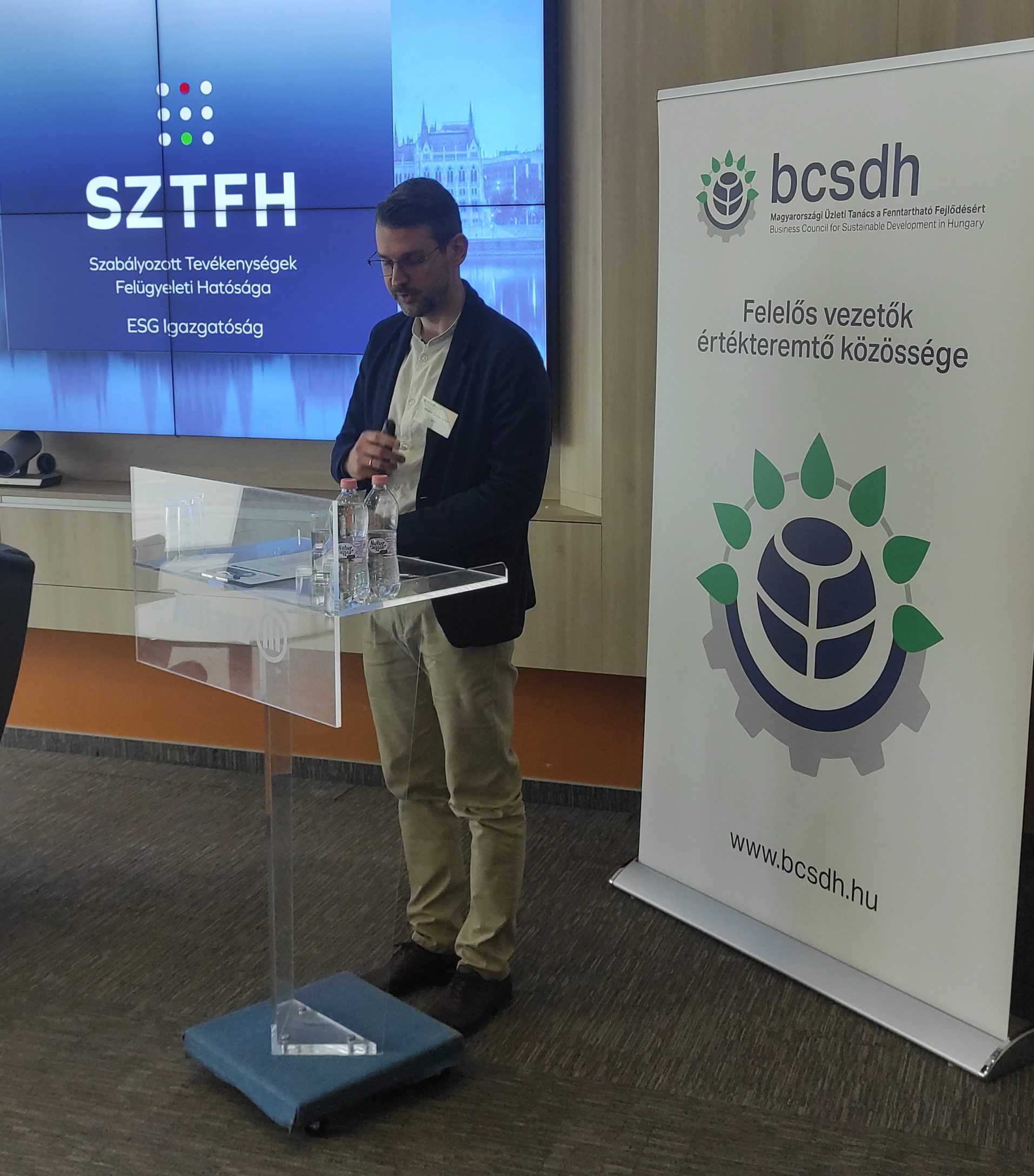
He was followed by Nikolett van der Wildt, Sustainability and PR Manager, who talked about the biodiversity project in the area of the factory in kékkút, emphasising that they had been inspired and partnered in a previous working group meeting. Among the many elements of the long-term programme are an artificial pond, a swallow wall and an insect hotel. The water resources of the Káli basin will be protected by monitoring wells and groundwater regulation.

Afterwards, Dávid Kovács, Marketing Director of Zwack Unicum, spoke about the sustainability goals and areas, and we learned, among other things, that between 2016 and 2020, the company achieved a CO2 reduction of more than 200 elephants (about 1200 tons) at the company level. He also gave a detailed presentation of the geothermal conversion of their plant in Dunaharaszti, the process and challenges involved. The half a billion forint investment could not have been realised without the long-term commitment of the owners, and the development, which was handed over this year, is already showing good figures: gas consumption has been reduced by 20% in 6 months.


Half a year ago, Daniella Huszár, HuGBC’s sustainability coordinator, spoke about the Advancing Net Zero initiative in the framework of the working group, and now she talked about the results and programmes of the period since then. It is very important to underline that the built environment has a huge role to play in reaching the 1.5 degrees target and halving carbon emissions by 2030. To help decarbonise buildings, a Zero Carbon Recommendation has been published under the programme.


Finally, Andrea Nagy, BCSDH’s project manager, closed the working group with the presentation of two new publications. ” Nature-Based Solutions and Voluntary Carbon Markets – Corporate Buyer’s Guide “, edited by the Central Bank of Hungary, was prepared together with WWF and other member companies as a result of the joint work of the Nature-based Climate Solutions Working Group. This publication is the first public, tangible product of the Working Group and is intended to help companies and anyone interested in the topic to find their way around the market in a clear and accessible way.

A “CEO Guide” has also been produced, which contains the main findings of the long publication, with an active link to the original document. This will also help managers to get a quick overview of the topic, and they can read the details in the Corporate Buyer’s Guide.

Thanks to the sponsors of the Race to Zero program in 2023:


22.09.2023
https://bcsdh.hu/wp-content/uploads/2023/09/20230920_141939.jpg 900 2000 Nagy Andrea https://bcsdh.hu/wp-content/uploads/2021/12/bcsdh-logo.png Nagy Andrea2023-09-22 17:17:052023-11-27 19:59:36Swallows, elephants and carbon dioxide, unique corporate publications: diverse topics at the Race to Zero working group
Page 10 of 35«‹89101112›»
Followon TwitterSubscribeto RSS Feed

Latest news

Categories

  • Award
  • Business Solution Award
  • Business Transformation award
  • Change Leader Award
  • Kiemelt hírek
  • Leading women award
  • Member News
  • New member
  • News
  • új tagvállalat
  • Uncategorized

Archives

  • March 2026
  • February 2026
  • January 2026
  • December 2025
  • November 2025
  • October 2025
  • September 2025
  • August 2025
  • July 2025
  • June 2025
  • May 2025
  • April 2025
  • March 2025
  • February 2025
  • January 2025
  • December 2024
  • November 2024
  • October 2024
  • September 2024
  • August 2024
  • July 2024
  • June 2024
  • May 2024
  • April 2024
  • March 2024
  • February 2024
  • January 2024
  • December 2023
  • November 2023
  • October 2023
  • September 2023
  • August 2023
  • July 2023
  • June 2023
  • May 2023
  • April 2023
  • March 2023
  • February 2023
  • January 2023
  • December 2022
  • November 2022
  • October 2022
  • September 2022
  • August 2022
  • July 2022
  • June 2022
  • May 2022
  • April 2022
  • March 2022
  • February 2022
  • January 2022
  • December 2021
  • November 2021
  • October 2021
  • September 2021
  • August 2021
  • July 2021
  • June 2021
  • May 2021
  • April 2021
  • March 2021
  • February 2021
  • January 2021
  • December 2020
  • November 2020
  • October 2020
  • September 2020
  • July 2020
  • June 2020
  • May 2020
  • April 2020
  • March 2020
  • February 2020
  • January 2020
  • December 2019
  • November 2019
  • October 2019
  • September 2019
  • August 2019
  • July 2019
  • June 2019
  • May 2019
  • April 2019
  • March 2019
  • February 2019
  • January 2019
  • December 2018
  • November 2018
  • October 2018
  • September 2018
  • August 2018
  • July 2018
  • June 2018
  • May 2018
  • April 2018
  • February 2018
  • January 2018
  • December 2017
  • November 2017
  • October 2017
  • September 2017
  • May 2017
  • April 2017
  • March 2017
  • February 2017
  • December 2016
  • November 2016
  • October 2016
  • September 2016
  • August 2016
  • July 2016
  • June 2016
  • May 2016
  • April 2016
  • March 2016
  • February 2016
  • December 2015
  • November 2015
  • October 2015
  • September 2015
  • August 2015
  • July 2015
  • June 2015
  • April 2015
  • March 2015
  • February 2015
  • January 2015
  • December 2014
  • November 2014
  • October 2014
  • September 2014
  • August 2014
  • July 2014
  • June 2014
  • May 2014
  • April 2014
  • March 2014
  • February 2014
  • January 2014
  • December 2013
  • November 2013
  • September 2013
  • July 2013
  • June 2013
  • May 2013
  • April 2013
  • March 2013
  • February 2013
  • January 2013
  • November 2012

Business Council for Sustainable Development in Hungary
1118 Budapest, Ménesi street 9/a.

About us
Our mission
Our vision
Our Members
Annual Report
Contact

Carbon-aware events
Gallery

Policies and statements
Privacy policy
Competition Law Statement
Code of Ethics

World Business Council for Sustainable Development (WBCSD) National Partner

© Copyright - BCSDH - powered by Enfold WordPress Theme
  • Facebook
  • LinkedIn
  • Mail
Scroll to top