
Business Council for Sustainable Development in Hungary
1118 Budapest, Ménesi street 9/a.
Policies and statements
Privacy policy
Competition Law Statement
Code of Ethics
World Business Council for Sustainable Development (WBCSD) National Partner
Social issues are receiving increasing emphasis in the business world, as growing inequalities carry systemic risks.
What can companies do to reduce social inequalities? What workforce trends should they prepare for in the near future? How can we support innovation in social issues by aligning with values? What psychosocial risks are present in the workplace? These were the topics that were discussed during our joint ESG and Social Capital Working Group meeting on April 27, 2023, with the participation of around 35 people, hosted by Randstad Hungary.
The participants of the joint working group were welcomed by Gréta Nagy, leader of the ESG Working Group and CEO of Dandelion, and Attila Kelemen, leader of the Social Capital Working Group and President-CEO of ProSelf International Ltd. They emphasized that social issues are gaining increasing importance in the business world, as the success of every organization depends on its people, i.e., colleagues, partners, and consumers.

Sándor Baja, the CEO of Randstad Hungary, presented the latest trends and indicators characterizing the Hungarian labor market in his presentation. He emphasized that in the uncertain economic environment, the financial stability of employers has become significantly more important. At the same time, the importance of work-life balance has further strengthened compared to the previous year.

Ágnes Vörös, Head of HR and Administration Hungary at BASF, and Kristóf Kovács, founder and trustee of the Invisible School Foundation, presented the Invisible School program, an exemplary initiative where volunteers support the academic development, vocational orientation, and social integration of children living in temporary homes through mentorship programs, personal tutoring, and summer camps.

Lajos Csaba, Deputy Head of PR and Government Relations at Richter Gedeon Nyrt., presented how the Richter Anna Prize helps the company contribute to the development of social issues such as education, healthcare, and pharmaceuticals. They support innovative ideas aimed at improving working conditions and service quality. The winning projects can serve as best practices on a wider scale.

Gréta Nagy‘s presentation focused on the issue of workplace stress. She emphasized how creating a trusting atmosphere, ensuring safety, and establishing balance greatly contribute to the mental well-being of employees.
To conclude the event, Zsófia Galambosné Dudás, Professional Project Manager of BCSDH, presented the organization’s plan for the new CSRD training.
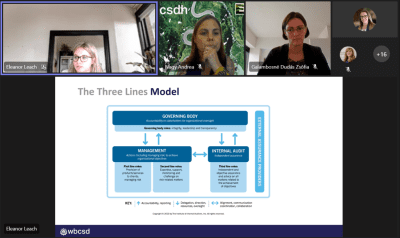
How are ESG aspects embedded into company operations? The meeting of the BCSDH ESG working group also discussed the theory and practical implementation of this. Eleanor Leach introduced the WBCSD – World Business Council for Sustainable Development’s guidance developed in collaboration with the Institute of Internal Auditors on embedding ESG and sustainability considerations into the Three Lines Model. Afterwards, we heard an exciting presentation from Mátyás Bellaagh, Director EHSQ, CSR & BIM at Colas, about the challenges and opportunities of ESG integration and the importance of stakeholder involvement in the entire process.
 |
 |
Our fourth ESG working group meeting on 19th October exceeded all our expectations. Our guests speakers were Sándor Baja, Managing Director of Randstad Hungary Kft. and Björn Claussen, Regional Head of Multinational Coverage – Central Europe BNP Paribas, winner of the “For a Sustainable Future” Award in Change Leader category.
Sándor led us through the current Hungarian labor market situation, summarizing the challenges and possibilities, partially driven by Covid-19. We can currently see a clear gap between the number of people retiring vs. the number of 18 years old population. As the Eastern European countries are seemed to recover faster than the Western countries, we can witness some migration back to Hungary. Additional challenges are given by the facts that governance is decreasing the number of work permit issued, meanwhile the number of high education graduates are also decreasing. Hungary is not well prepared for the future job market, where continuous automation plays a key role, making mid-level jobs disappear. Today we can say that automation is creating more jobs then eliminates. STEAM education is rising in the western countries while in Hungary we are only around 20% and female students are even more underrepresented in the area. Regarding mobility we see a rising trend on urbanization as well as connecting small villages to the big company circulation due to remote and hybrid work possibilities.

Sándor also shared a new Randstad survey, what was conducted with the involvement of 7600 people, covering the topics of Covid-19 effect, employer of choice, remote work, employee retention and employee drivers.
Some of the key highlights are the following:
Björn, representing the finance industry, started with a reflection on the Randstad report, how the sector lost its charm and now aims to offer more attractive opportunities for candidates. The role of a finance expert is becoming more and more advisory, who supports their clients to gain knowledge on global emerging trends, risks, and opportunities for a sustainable future. BNP Paribas has been carbon neutral on its operational scope since 2017 and was recognized multiple times for their work around ESG and sustainability worldwide.
The bank is redesigning its strategy to be even more action oriented by realigning their activities with the SDGs and how they can land money in another way. 15% of their investments is contributing strictly to the achievement of the UN SDGs. During the last 5 years they tripled their investment on renewable energy sector and reached their goal with two years in advance. They also started to invest in startups for energy, energy transformation, and efficiency areas, where after the 1st 100 million EUR spent, they partnered with another organization to further invest in the energy transition.

Bjorn also shared with us, what are the roadblock in their journey and how they are trying to overcome them. To reach their 2 Celsius commitment, BNP Paribas is gradually exiting some of the key industries as tobacco and coal. To make clients realize that the change is happening, they roll-out their exit strategies at the same time on a global scale, talking to clients one by one. Challenges are differently present in countries, where the governance is not committed on the same way towards the massive emission reduction. Beside the advisory approach, Bjorn continuously highlighted the importance of education and raising awareness around ESG, what is also part of their client management strategy.
BNP Paribas also conducted a survey on ESG recently. Some of the core findings are the following:
To watch a short video about the survey, click here.
Thanks for our sponsors:

The aim of the ALTEO’s Sustainability Barometer was to see how a potential investor thinks about sustainability, thus have a deeper understanding on people’s approach on sustainability. ALTEO’s survey was conducted among Hungarian Internet users between the age of 20 and 65 with a sample size of 1.000 people representing the gender, age and educational background of the population, and the type of settlement where they live. The questions focused on the awareness of environmental problems, concrete actions how people protect the environment, moreover how they deal with their investments.
The majority of Internet users in Hungary between the age of 20 and 65 are interested in the environment protection, 82% believe that environmental problems also impact their lives, but 32% are not yet convinced about it currently being one of the most important tasks that people have. According to 80% of the respondents, everyone is responsible for environmental problems, while 19% blames corporations, countries and global organizations. Women more typically share a sense of community, while men tend to pass responsibility on to companies.
Attila also covered the topic of investments. The majority claimed that they would prefer a financial product if it also took sustainability into consideration.
Further information can be found about the results in hungarian here.

Annamária shortly introduced their company to the participants, as ALD Automotive Hungary is a fresh member of our community. Their beliefs say, that economic development is no longer possible without environmental progress, thus the company joined the road of sustainability on a group level. They find third party evaluation a great opportunity to challenge themselves. ALD Automotive Hungary has been assessed by Ecovadis first in 2018, and had been granted a gold recognition level.
Annamária then summarized the basics of the Ecovadis methodology, which follows four topics, environment, labour and human rights, ethics and sustainable procurement. They received a very detailed, up-to-date report on their strenghts and the areas that need improvement, also sharing hints how to improve each area of their company. This way they have a very clear view on where they are and where they are headed to, also receiving a silver medal in 2020.
It is of great importance for them to bring sustainability close to people, their employees, partners and clients, as the presentation was closed with their own CSR programs. Her presentation confirmed, that Corporate Social Responsibility is in the heart of their business.
Sorry, no posts matched your criteria
Business Council for Sustainable Development in Hungary
1118 Budapest, Ménesi street 9/a.
Policies and statements
Privacy policy
Competition Law Statement
Code of Ethics
World Business Council for Sustainable Development (WBCSD) National Partner