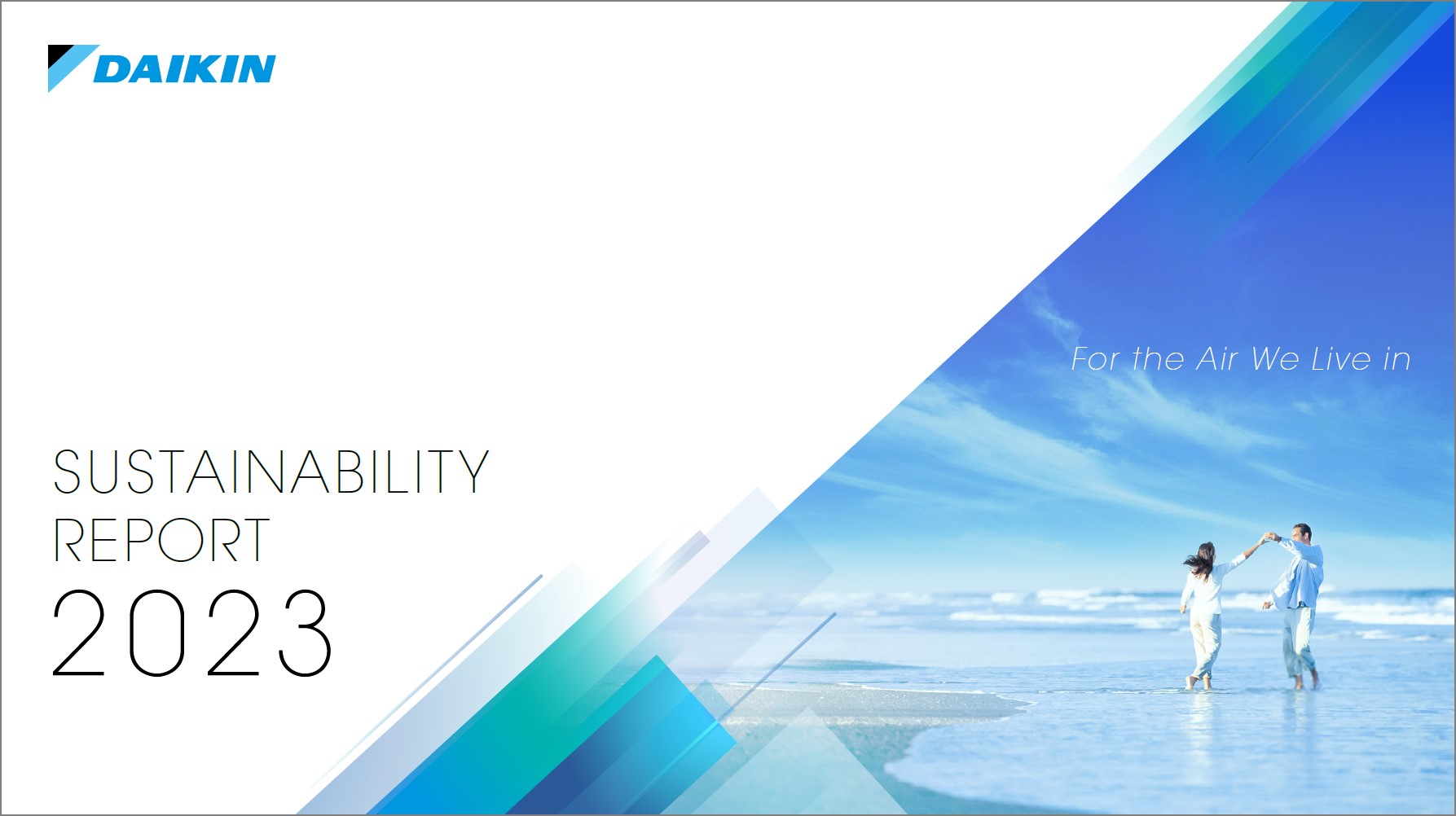
Daikin has published its global Sustainability Report 2023. The report summarizes Daikin’s worldwide ESG data and outlines the fundamental strategy of the Daikin Group in advancing towards a sustainable society through its business activities. The English edition of the report by Daikin Industries Ltd. (DIL), the Japanese mother company of Daikin Europe N.V. (DENV), also covers the company’s fiscal 2022 results and plans for the future.
Brussels, September 2023 – In recent years, there has been a worldwide push to reduce carbon emissions. As a leading company in the HVAC-R industry, Daikin introduced its Environmental Vision 2050 back in 2019, a commitment to attain net-zero greenhouse gas emissions by 2050 across the full life cycle of its products and solutions. Its commitment to reach carbon neutrality is a key theme in the Group’s strategic 5-year management plan called Fusion 2025. In the plan’s mid-term review in May this year, Daikin introduced further actions in addition to existing activities. New objectives include establishing net-zero CO2 emissions at all its HVAC-R offices and factories by 2030, as well as supporting the adoption of heat pumps in the European heating market. Daikin is committed to pursuing the growth of the Daikin Group, while taking up its responsibility in building a more sustainable society.
Highlights from the Sustainability Report 2023
Information disclosure aligned with the TCFD Framework
The company endorsed the recommendations of the Task Force on Climate-related Financial Disclosures (TCFD) in 2019, conducted an analysis of the risks and opportunities posed by climate change to its business, and reflected them into its management strategies and risk management.
During this fiscal year, Daikin made projections for the anticipated carbon tax in 2030, considering both 4°C and 1.5°C scenarios, and presented the resulting financial impact.
Reaching carbon neutrality with heat pumps
In contrast to traditional combustion heating methods, heat pump heating is gaining recognition for its capacity to substantially diminish CO2 emissions. This section of the report showcases key initiatives in Europe, where the market is experiencing rapid growth, and outlines forthcoming strategies for business expansion.
Human capital: advancing business transformation through digital transformation
Daikin established its Information and Communications Technology College in 2017 to cultivate internal talent for digital transformation. The report includes real stories of how alumni have played pivotal roles in different departments by harnessing digital technology, leading to the inception of new ventures and enhanced operational efficiency.
Outcomes of sustainability initiatives in the fiscal year 2022
The report presents a comprehensive account of the strategies, organizational setups, performance objectives, and outcomes pertaining to fiscal year 2022 for each of the ESG domains: Environmental, Social, and Governance.
Data
Quantitative data along with various philosophies and policies have been compiled.
More information
Starting with the 2023 edition, this report will be made available in PDF format on the Daikin website to enhance the accessibility of ESG information. Access is available via www.daikin.com/csr/report

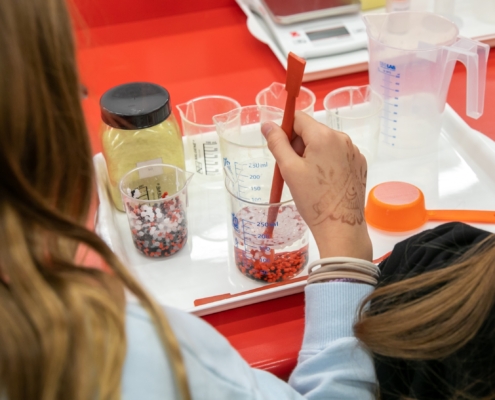 “Environmental protection cannot wait, it is important for us that Debrecen remains a liveable, clean and sustainable city in the coming decades,” the head of the Mayor’s Cabinet Office highlighted at the press launch of PlasticLab. “We are proud to have companies like BASF as allies in achieving our green goals and raising awareness among the youth of Debrecen,” added Dr. Kovács.
 The first Kids’ Lab was opened in 1997 at BASF’s headquater in Ludwigshafen, Germany. Its aim is to provide a memorable first encounter with a laboratory for primary school children. In a safe and specially designed environment for children, students can conduct experiments under the guidance of professionals. The workshops foster curiosity and research spirit in children, who gain insight into scientific working methods through their experiences and are encouraged to take a creative approach to scientific issues. So far, primary school children have been introduced to the exciting world of chemistry at two Kid’s Lab workshops in Debrecen. Following the success at BASF’s headquarters in Ludwigshafen, the educational program known as PlasticLab, with a focus on environmental protection and sustainability, will now be accessible to students in the Southeast European region, specifically in Debrecen, Hungary.
 Worldwide more than 1.2 million young people from 45 countries have participated in the educational programs offered by BASF.
 School groups interested in BASF’s educational programs can apply through the Agóra Science Center website.


